This is a special post for quick takes by NunoSempere. Only they can create top-level comments. Comments here also appear on the Quick Takes page and All Posts page.
My team at Sentinel produces a weekly brief on global risks. Here is the executive summary for this week:
- Geopolitical risks: Thailand and Cambodia exchanged fire, and Thailand sent some F-16s into Cambodia, but a ceasefire has already been reached. Israel is being accused of causing mass starvation in Gaza by the WHO and others. Zelensky faced his first large-scale domestic protests over a law weakening the independence of anti-corruption bodies.
- Economy and trade: The US and the EU reached a trade deal that would tariff EU goods coming into America at 15%. A similar agreement was reached between the US and Japan, which will now also face 15% tariffs on its goods exported to the US.
- Biorisks: A paper reports a method for genetically editing mosquitoes to make them resistant to malaria in a way that can be transmitted to subsequent generations, and a method for driving such mutations into mosquito populations. H5N1 continues to pose an ongoing risk.
- AI: The White House published an extensive AI Action Plan, which seeks to accelerate investment and buildout and espouses a framework of a race against China, while also recognizing some potential dangers from AI and including some recommendations for research on controllability and safety. Anthropic is embroiled in a new trial over pirating IP; forecasters assign a 68% chance that the case will reach a jury trial, and a 56% chance that $1.5B damages will be awarded conditional on losing a trial, but only a 1.1% chance that Anthropic will be out of business by the end of 2026 as a result of the trial.
- Gray swans: None detected this week.
Our status is at green, representing that we aren’t seeing signals of incoming catastrophic risks over the short-term.
You can read the rest of it & sign up here.
 1
1 1
1One small suggestion: When I read this, I genuinely couldn't tell whether "Gray swans: None detected this week" was a joke (like you were pretending to look for literal gray/black swans), or if it meant something serious. After reading your website, my guess is that it's meant to be serious---but I'm still not sure, and if it is serious then I don't know what it means. (My understanding is that "black swan" means an unexpected, highly improbable / out of distribution event, so it wasn't clear to me what it would mean in this context to be generally looking for global gray/black swans.) Might be worth clarifying or finding other terminology, if you want readers like me to quickly grok what you mean.
what it would mean in this context to be generally looking for global gray/black swans
Yes it's a bit tongue in cheeck, but the point of black swans per Taleb is that they would be so out of distribution that they'd be totally unforeseen. But if you have a foresight team, maybe you can detect some fraction of them beforehand... in which case maybe they were not true black swans after all. Maybe I should just go with "out-of-distribution threats"
Interesting turn of events for the US to now disincentivize trade with Japan, wonder what Commodore Perry would think
Jamie Joyce seems like a better than replacement candiate for the 12th California Congressional district
Jamie Joyce seems like a better than replacement candidate for the 12th California Congressional district, which includes Oakland and Berkeley. She came second in the primary, meaning that she will be in the ballot in November. Here is her Ballotpedia page.
I know her from the FLF fellowship last year. She is not a candidate which embodies rationalist mores, but is rather more bubbly and normal. However, worries about AI are at or near the top of her policy agenda (framed as a proposed act of Congress named the “MAD act”), and she is generally able to integrate worries about AI safety with other mainstream issues. That is, she is not a rationalist candidate, but is one cadidate which rationalists could form part of a coalition to elect.
Her opponent is a very mainstream & uninspiring Democratic politician.
Unlike Alex Bores’ campaign, which is far away in NYC, California’s 12th Congressional district is right in the seat of the rationalists’ power. This means that acts like canvassing, putting up posters, etc. would be much cheaper to do. Shooting from the hip, maybe I’d give her a 10% chance of success on her own, and a 20% chance if the rats meaningfully back her (e.g., she gets 30% as much effort thrown into her campaign as the Alex Bores has). But I haven’t thought deeply about these probabilities.
Doing some quick math, if there are 2k to 10k rationalists in Berkeley, and they each can convince 2 to 10 friends, that’s 10k to 70k votes. This would be a big chunk of the overall population of 750K inhabitants, and a pretty big chunk of the 150K-190K votes one would have needed to win the 2024 election for that same district. So again, rationalists alone would not be able to win the election, but could as part of a coalition.
Per the Ballotpedia page, Jamie raised $14K so far and spent 10k on the primary, winning 28K votes (!!), meaning getting a vote for 36cts, which seems fairly efficient. In contrast, the incumbent spent $861K for 153K votes, or $5.6 per vote. I.e., the incumbent probably overspent on the primary, in a show of strength but also of inefficiency. The incumbent has $687K on hand.
If one needed to get 150K-190K votes to win past years, and Jamie could keep up the 36cts per vote, she’d need 40-60K to win the general election. This seems too low. On the other hand, $350K probably does moves her chances of winning by 10%, which would be 1.75M for a representative, which still seems like a very attractive proposition. My general sense is that another $100k would probably be fairly helpful. For contrast, Bores has raised $3.6M; this makes me think that Jamie is competitive for the marginal $300K from an EA/rat/safety perspective.
I’ll send this to a few people in the EA/rat politics scene (e.g., Eric Neyman), but in general my sense is that people excited about Bores should also view this as an interesting opportunity. Jamie can be contacted rep@jamiejoyce.com, or on her LessWrong account, and is probably up for having conversations with people here.
 3
3Her MAD Act includes things like "investigating the Charlie Kirk assassination" (suggesting a link to Israel), checking whether Ghislaine Maxwell is really in jail or replaced with a fake (suggesting a link to Israel), and using AI to constantly surveil all government officials for the sake of accountability.
Having a conspiracy theorist shout about AI risks in the House would backfire massively for any hopes of Congress taking those risks seriously.
Hey! Thanks for looking into the MAD Act, but I would push back on your framing (I know how it looks, totally fair to think it's out of bounds) but I think you are mischaracterizing the material, perhaps intentionally.
Folks in government do take me seriously. I have been asked to present internally to gov departments in both Canada and the U.S.. Just last year, I was invited to present internally on declassification at NARA alongside reps from the Applied Research Laboratory for Intelligence and Security as well as a folks from project CoNGA from the National Geospatial-Intelligence Agency. If you spend sufficient time looking through declassified records as I do, it becomes very normalized to suggest certain formal inquiries should take place. I think your impression comes from a lack of understanding our history, but if you take a cursory glance at these issues only, I can understand the impression. It could be totally fruitless inquiries, but such inquiries serve to dispel misinformation held by other stakeholders as well.
I have been a solid and professional researcher for about 8 years, and was early on things like Epstein, COVID being a potential lab leak, etc., when folks found these topics to be unreasonable. I think my background in exploring internet commentary trends at scale coupled with the systematic logical deconstruction of such claims for the purpose of adjudicating evidence simply puts me ahead of the curve on some topics, sometimes - and I think that's the case here. I am not asserting anything on these topics, merely calling for an inquiry and verification.
In general, these topics are validated and important to other audiences. I suggest folks read the actual articles. Also your note about "AI to constantly surveil all government officials" is a completely inaccurate characterization, hence my assumption that this may have been intentionally mischaracterizing.
 1
1All this to say, @orthonormal, I think your conclusion is incorrect. Given the history of how folks in the DoD, DARPA, IARPA, NARA, ISOO, the Stimson Center, and the CSPS/EFPC have taken me quite seriously over the years, I think the Gang of Eight will as well.
But thank you for giving me the opportunity to refine how I would respond to such critiques, since my first reply was suboptimal to be sure.
Your frame is really strong. I agree that Jamie is not a rationalist. I think that those beliefs are not that out there in comparison to major religions, mainstream political beliefs, etc. They are also not completely unhinged: looking at the Charlie Kirk link, she is calling for a more thorough investigation given that TPUSA was a major organization, and sure, looking at Israel's influence.
Ultimately I like her personally and my sense is that allying with her would be a good idea since I don't think you can get a rationalist candidate to run/win
Joyce lost the primary 16-84. It's hard for a Dem challenger to beat a Dem incumbent, especially without a stellar resume or establishment support.
"36cts per vote" is not accurate; Joyce would have gotten almost as many votes if she'd spent $0. "$350K probably does moves her chances of winning by 10%" is big if true but I (tentatively, with little info) think it's <<1%. I wish her well but I don't think this is a promising donation opportunity on the basis of flipping the election.
Hello Zach! Thank you for wishing me well. However, I don't believe your assumption is accurate regarding the default that I would have gotten as many votes spending $0. Jennifer Tran, who was more political engaged in the community before running in the last election, took only 14.7% in the primary when facing Simon. I believe Tran raised about $168,000 for the primary and spent almost all of it. It was a more crowded race then, and Simon wasn't an incumbent yet, but still. Also, I don't believe Tran ever got national attention throughout the race (I've been covered in national press twice, without much campaigning, since I started the election very late).
Although I am certainly not the establishment pick, I find there are lots of folks in the district displeased with Simon's performance. Folks who I have met since the Primary have told me they regret their vote for her in the primary, simply because they didn't know about me yet and that I have strong policies they agree with - plus a background in AI and government records - which are actually priorities in this district. Simon talks often about AI and the Epstein files, though she has no expertise in either. I've been endorsed by 3 Epstein survivors. I do think my biggest hurdle is concerning reaching voters, which of course is grossly limited because of my extremely limited funds.
In terms of strategy, there is a lot more I could share which I believe could position me very strongly, but I will not post it publicly. However if you would like to have a phone call about it, I am wondering if what I could share would change your calculation.
- Candidate page: https://www.fec.gov/data/candidate/H4CA12196/
- Itemized disbursements (every expenditure): https://www.fec.gov/data/disbursements/?committee_id=C00841288&two_year_transaction_period=2024
 1
1Joyce lost the primary 16-84
This is true. It is also true that she only needed to get to second place in order to go into the general election https://www.lesswrong.com/posts/RPsgjBsAbAuRQegjm/nunosempere-s-shortform?commentId=2FEX6ugL5DDyxGY5F

I talked to her back in 2022 and one of the main things she was up to then was preparing society for AI and for debating AI so I know she's been interested in AI Safety for 4 years fwiw.
Jamie raised $14K so far and spent 10k on the primary, winning 28K votes (!!), meaning getting a vote for 36cts, which seems fairly efficient.
For figuring out spending effectiveness, the question is how many votes she would have gotten if she hadn't spend any money on the primary. My guess is, perhaps, a couple hundred fewer votes.
I am not sure about that. What makes you think so? Spending around 15k divided by $200 means that budget bought 75 votes, yeah? What we spent the money on in terms of outreach: texting the ~50k NPP (if I am recalling the number correctly) and the republican voters in the district, specifically between the topics of Israeli influence in government affairs, Epstein files, and the Kirk investigation mean more to those voters. I have been flipping former Simon voters to my side, but that is what is expensive. However, I've found a lot of the older, wealthy dems do care a lot about AI and have concerns about it (not polling, just anecdotes).
Another anecdote: Simon is popular, but one person who refused to even speak with me because she was pro-Simon has since come around and now has my yard sign in her front yard and she defends me to her neighbors. Simon is popular, but it only takes a little digging to see how voters would change their mind on her. Not something to post publicly, though.
Mmmh, good point. What's your guess about cost per vote for the general? Seems cruxy to figure out.
My guess would be something like: starts at $200/vote and then gradually falls off as diminishing marginal returns kick in.
But in terms of my overall appraisal of the situation, I'm operating under a different heuristic: incumbents are very difficult to beat unless they are unpopular. And, as far as I know, Lateefah Simon is perfectly popular.
A heuristic I've heard used is that spending on advertising in primary elections in inexpensive media markets has an effect of roughly $100/net vote. On the other hand, Berkeley is an expensive area to run ads, so it should be higher.
(And this should be treated as a primary election, because it's a Democrat vs. Democrat contest.)
Sometimes we see races where one side starts spending large amounts all of a sudden and the polls shift; this lets us get an okay-but-not-great measurement of the cost-effectiveness of ads. See eg here (search "Iowa") for an example -- though admittedly that was spending by a super PAC, which is generally somewhat less effective than campaign spending, so you should divide those cost estimates, maybe by a factor of 1.5 or so.
Might be understating Jamie's rationalistadjacentness - take a look at societylibrary.org! I also met (and championed) Jamie through the FLF fellowship last year.
In general, would folks here just like to meet up in person and learn more about the strategy/plans I have that I wouldn't post about in public?
I am not entering this race blind to the odds (I knew it was a long shot), but there is a narrow path to advance the MAD Act, and an even narrower path would be that I take the seat, but I have just grown so incredibly concerned about issues that I had to throw my hat in the ring to raise awareness about them.
If folks want to learn more about me: https://www.jamiejoyce.com/jamies-background
Huge +1 on this. I read up on her, found her a likely pick and expected basic operational competence from the political arm of EA/AIS, forgot about her, read up on her again when I voted for the primary, realized I'd heard nothing more on her (by contrast with Bores), and shrugged and voted for her. It's probably too late at this point; shame. A congressman from Berkeley saying AIS/ratsphere things would have been huge.
Huge +1 on this
Thanks!
probably too late at this point
Not so! She got second place in the primary, which means that she can go to the general election! Very little point in flashily winning the primary since there are funny nonlinearity effects in causing the incumbent to take the general election more seriously.
 1
1 1
1Not so! She got second place in the primary, which means that she can go to the general election! Very little point in flashily winning the primary since there are funny nonlinearity effects in causing the incumbent to take the general election more seriously.
Oh, huh. I'd have thought that given that the primary was two-person, the incumbent would have won with an outright majority and won overall? If it's not too late then maybe it really might be worth writing her. I'll dash off an email or two today.
Thank you so much! It is a jungle primary in California, so the incumbent and I do advance to the general.
Yes, my understanding is that it is indeed drafted with AI, with Jamie giving overall direction.
Yes, I used LLMs to format and standardize language in the HOLC format. It seemed a waste of time to do that 'by hand." I stopped counting at around 300hrs of research and initial drafting on the MAD Act, and I needed to start campaigning, since I was already a late entrant.
What do you think the chances are, if the rstionalists really take this up, of producing a counter response/funding from the accelerationist contingent or the aI superpac?
🟪 Wide-spread epistemic anomaly detected || Global Risks Instant Message #01-04-2026
We are detecting today a shared collective delusion leading victims to degrade their epistemic standards. This anomaly is aimed towards no particular end, except perhaps for the amusement of its participants and the satisfaction of ingenious expression.
So far, it appears to be mostly harmless. Nonetheless, this phenomenon creates space for vulnerabilities. If some geopolitical actor were to take some implausible action on this day (for instance, US to invade Canada, Spain to annex Portugal, Iran bombing the Bulletin of the Atomic Scientists), it would be initially harder to coordinate effective responses against it, since other actors may initially doubt whether the facts reported are real or lark. If there is broad societal license to fib, the power of contracts might be imperilled: OpenAI could announce AGI today, thus freeing itself from its obligations to Microsoft, without having the declaration be interpreted literally. [Make this more tenebrous].
There is precedent for actions and announcements made in this altered epistemic state manifesting after its ending, such as the launch of Gmail.
One formulation for the harmfulness of a lie is Mariven’s operationalization of deception:
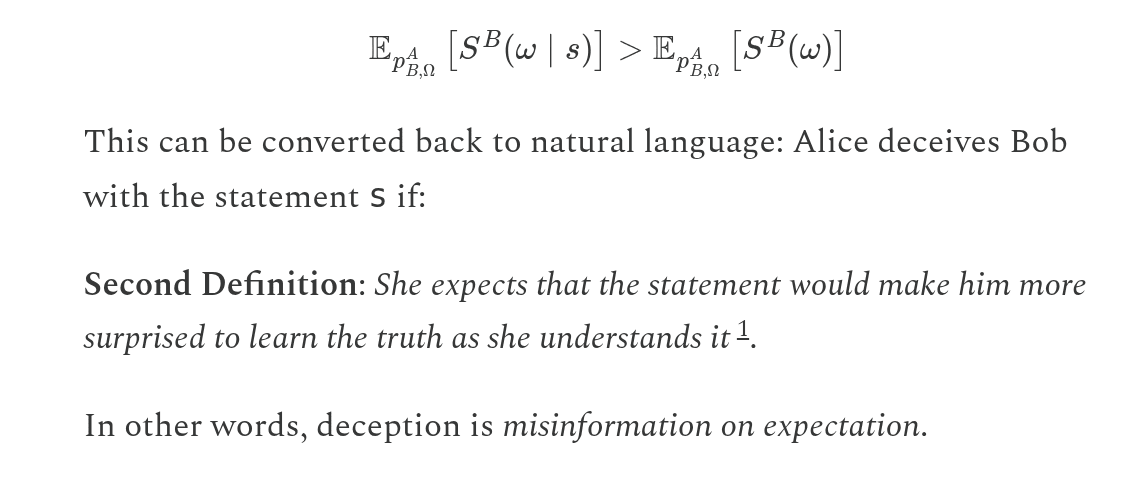
From this perspective, since the modus operandi of artifacts produced in the delusion we are monitoring is revealed before recipients have a change to propagate their beliefs and take action based on them, it's not clear that it isn’t clear that the degradation in epistemic standards we are observing are having large-scale harmful effects.
It is also not coordinated centrally, but rather arises organically and in an uncoordinated fashion. The spontaneity and wide spread of this anomaly suggests that there may be other, perhaps many other shared spontaneous delusions arising and shaping our behaviour, like enthusiasm for crypto, the belief in fiat currency, the hope that things are going to be all right, the collective agreement to mutually ignore our glaring flaws, the perception that important decisions in the West are made democratically.
Based on a study of the historical duration of previous such incidents, we expect this epistemic anomaly to be bounded in time to about a day.
Year | Duration of April Fools’ day |
2020 | 1 |
2021 | 1 |
2022 | 1 |
2023 | 1 |
2024 | 1 |
2025 | 1 |
My team at Sentinel produces a weekly brief on global risks. Here is the executive summary and forecasts for this weeks:
Key items this week are:
- Economy and trade: Trump announced new tariffs. US GDP growth is driven by AI capex spending while labor slumps. In response to an unfavorable labor report, Trump fired the commissioner of the US Bureau of Labor Statistics.
- Geopolitics: UK, France and Canada announced their intention to recognize a Palestinian state. Hunger is widespread in Gaza and might meet the technical definition of famine later this year, which could serve as a Schelling point for change.
- Biorisks: Crimean Congo haemorrhagic fever and Chikungunya are spreading. A paper on an AI pipeline for AI-aided discovery of antivirals provides hope for a favorable defense/offense balance change for AI.
- AI: Mark Zuckerberg wrote about personal superintelligence, and Google released a variant of an IMO gold medal model.
- And more: Drug-cartel operatives volunteered in Ukraine to gain experience with FPV drones, and prisoners in the UK are using drones to smuggle goods into prison.
We updated our forecasting estimates for the following;
- Will there be a famine in any part of Gaza by the end of 2025, according to the UN and its Integrated Food Security Phase Classification? In March, our aggregate estimate for this was 18%, it is now 41% (range 25% to 50%).
- Will there be a ceasefire between Israel and Hamas that lasts at least a week, beginning in the next 30 days? We estimated a 44% chance that this would happen a month ago, and it did not. We currently estimate that there is a 17% chance that one will happen in the next 30 days and last at least a week (range 12% to 25%).
- Will Israel and Hamas still be fighting at the end of the year? We estimated a 64% chance of this last month; we now estimate a 62% chance (range 35% to 75%).
- Will Meta have the most capable general purpose AI system internally, on 31 December 2025? In March, we produced estimates about which AI company this would be, with Meta bucketed under “other” (11%). Our current estimate for Meta achieving this is 8% (range 5% to 18%).
Our status is at green, representing that we aren’t seeing signals of incoming global catastrophic risks over the short-term.
Our status is at green, representing that we aren’t seeing signals of incoming catastrophic risks over the short-term.
You can read the rest of it & sign up here. We also appreciate retweets this week since we changed to this twitter account.
 1
1This interview with a drone expert on AI warfare did fairly poorly on LW, but it has a bunch of juicy information people might want to read.
Here is the executive summary and few sections for this week's brief on global risks, by my team @ Sentinel.
- Geopolitics: Trump and Putin met in Alaska to discuss the Ukraine war. Forecasters’ estimate of the chance of a ceasefire by October dropped from 27% pre-summit to 9%.
- Biorisks: The chikungunya virus continues to spread, including in France and the UK.
- Tech and AI: Meta’s policies explicitly allowed its AI chatbots to “engage a child in conversations that are romantic or sensual.”
- And more: Three soldiers were killed and four others injured in a drone attack by FARC dissidents on the Colombian military.
Geopolitics: Trump/Putin summit in Alaska
Trump and Putin met in Alaska to discuss the Ukraine war. Before the summit, forecasters estimated a 27% (15% to 40%) probability of a ceasefire by October 1. After the summit, our forecast dropped to a 9% probability (2% to 30%).
Before the summit, Zelensky told his European counterparts that he would be willing to formally cede territory that Russia already occupies in exchange for freezing the conflict along the current frontlines, while Putin was demanding that Ukraine withdraw its troops from the entirety of the Donbas in exchange for a freeze everywhere else (a demand Zelensky rejected). Trump also threatened “severe consequences” for Russia if a ceasefire wasn’t agreed, presumably in the form of more military aid to Ukraine and further sanctions and secondary tariffs on Russia. Still, based on the failure of previous talks, our forecasts for the chance of a ceasefire were significantly below 50%, although the fact that Trump and Putin were meeting at all was setting high expectations (with Trump claiming a 75% chance that the summit would be successful).
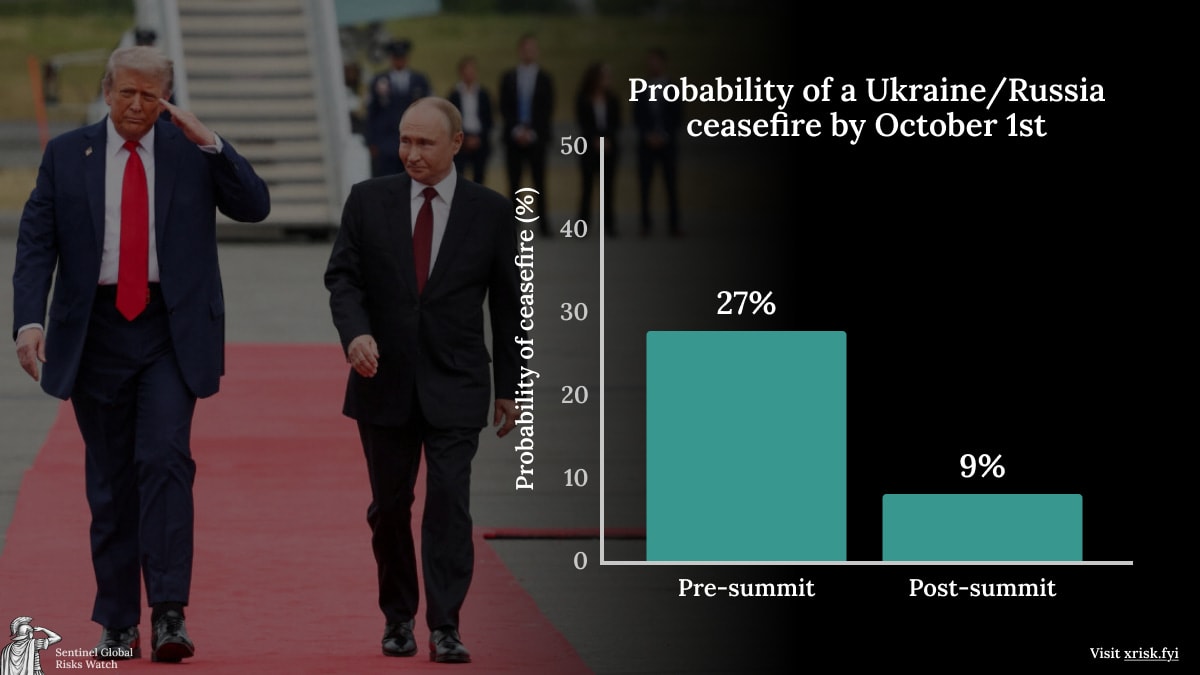
After the summit, forecasters consistently reduced their estimates. Trump didn’t take the chance to exert pressure, with US Secretary of State Marco Rubio arguing that further sanctions would only prolong the war. Instead, Trump adopted Putin’s position of aiming for a comprehensive peace agreement, which would likely take much longer to achieve, as there are many issues to resolve. With Putin proposing a land swap (potentially slanted 10-to-1 in favour of Russia) that puts Russian soldiers on the Kyiv side of the extensive defensive lines Ukraine has built, some of our forecasters believe there is a big gulf between the two sides’ positions, a sentiment echoed by Rubio. Others think that withdrawal from the Donbas might be acceptable to Ukraine if there are robust security guarantees for Ukraine as part of a peace deal, most likely in the form of European boots on the ground in the country.
rest of the brief here.
While researching past technological discontinuities, I came across some interesting anecdotes. Some follow. I also looked at technology readiness levels, but this didn’t prove fruitful.
Anecdotes and patterns
Watt's safety concerns
As the 18th century advanced, the call was for higher pressures; this was strongly resisted by Watt who used the monopoly his patent gave him to prevent others from building high-pressure engines and using them in vehicles. He mistrusted the boiler technology of the day, the way they were constructed and the strength of the materials used. ...Oliver Evans in his turn was in favour of "strong steam" which he applied to boat engines and to stationary uses. He was a pioneer of cylindrical boilers; however Evans' boilers did suffer several serious boiler explosions, which tended to lend weight to Watt's qualms. Source
This narrative has been later disputed, however, it does seem possible that awareness of the high risk of high-pressure engines, which were more susceptible to boiler explosions, delayed their development and adoption somewhat. In any case, the anecdote might be interesting for those who may seek to delay development of the capabilities of AI until safety technologies have been developed, either as a historical example or as a talking point.
Monetary bounties to incentivize progress
In April 1900, Henri offered the Deutsch de la Meurthe prize, also simply known as the Deutsch prize, of 100,000 francs to the first machine capable of flying a round trip from the Parc Saint Cloud to the Eiffel Tower in Paris and back in less than 30 minutes. The winner of the prize needed to maintain an average ground speed of at least 22 km/h (14 mph) to cover the round trip distance of 11 km (6.8 mi) in the allotted time. The prize was to be available from May 1, 1900, to October 1, 1903.[7]
To win the prize, Alberto Santos-Dumont decided to build the Santos-Dumont No. 5, a larger airship than his earlier craft. On August 8, 1901, during one of his attempts, the dirigible began to lose hydrogen gas. It started to descend and was unable to clear the roof of the Trocadero Hotel. Santos-Dumont was left hanging in a basket from the side of the hotel. With the help of the Paris fire brigade, he climbed to the roof without injury.[8]
On October 19, 1901, after several attempts and trials, Santos-Dumont launched his Number 6 airship at 2:30 pm. After only nine minutes of flight, Santos-Dumont had rounded the Eiffel Tower, but then suffered an engine failure. To restart the engine, he had to climb back over the gondola rail without a safety harness. The attempt was successful, and he crossed the finish line in 29 minutes 30 seconds. However, a short delay arose before his mooring line was secured, and at first the adjudicating committee refused him the prize, despite de la Meurthe, who was present, declaring himself satisfied. This caused a public outcry from the crowds watching the flight, as well as comment in the press. However a face-saving compromise was reached, and Santos-Dumont was awarded the prize. In a charitable gesture, he gave half the prize to his crew and then donated the other half to the poor of Paris.[9]
The first carriage-sized automobile suitable for use on existing wagon roads in the United States was a steam-powered vehicle invented in 1871 by Dr. J.W. Carhart, a minister of the Methodist Episcopal Church, in Racine, Wisconsin.[1][11][self-published source] It induced the State of Wisconsin in 1875 to offer a $10,000 award to the first to produce a practical substitute for the use of horses and other animals. They stipulated that the vehicle would have to maintain an average speed of more than 5 miles per hour (8 km/h) over a 200-mile (320 km) course. The offer led to the first city to city automobile race in the United States, starting on 16 July 1878 in Green Bay, Wisconsin, and ending in Madison, Wisconsin, via Appleton, Oshkosh, Waupun, Watertown, Fort Atkinson, and Janesville. While seven vehicles were registered, only two started to compete: the entries from Green Bay and Oshkosh. The vehicle from Green Bay was faster, but broke down before completing the race. The Oshkosh finished the 201-mile (323 km) course in 33 hours and 27 minutes, and posted an average speed of six miles per hour. In 1879, the legislature awarded half the prize.[12][13][14]
After the Scilly naval disaster of 1707 where four ships ran aground due to navigational mistakes, the British government offered a large prize of £20,000, equivalent to millions of pounds today, for anyone who could determine longitude accurately. The reward was eventually claimed in 1761 by Yorkshire carpenter John Harrison, who dedicated his life to improving the accuracy of his clocks. In 1735 Harrison built his first chronometer, which he steadily improved on over the next thirty years before submitting it for examination. The clock had many innovations, including the use of bearings to reduce friction, weighted balances to compensate for the ship's pitch and roll in the sea and the use of two different metals to reduce the problem of expansion from heat.
Non-neurotypical pioneers
Pioneers show a wide range of motivations. In particular, throughout the historical record, (lone) a non-neurotypical pioneer will occasionally obsess over a technology, refine it, make some progress, or leave a record of failed approaches. This may prove a hurdle for some safety approaches.
The following quotes are taken from their respective Wikipedia pages:
In the 1820s British inventor George Pocock developed man-lifting kites, using his own children as guinea pigs
In 1801, the French officer André Guillaume Resnier de Goué managed a 300-metre glide by starting from the top of the city walls of Angoulême and broke only one leg on arrival
The Jesuits were another major contributor to the development of pendulum clocks in the 17th and 18th centuries, having had an "unusually keen appreciation of the importance of precision". In measuring an accurate one-second pendulum, for example, the Italian astronomer Father Giovanni Battista Riccioli persuaded nine fellow Jesuits "to count nearly 87,000 oscillations in a single day". They served a crucial role in spreading and testing the scientific ideas of the period, and collaborated with contemporary scientists, such as Huygens.
Blyth's 10 m high, cloth-sailed wind turbine was installed in the garden of his holiday cottage at Marykirk in Kincardineshire and was used to charge accumulators developed by the Frenchman Camille Alphonse Faure, to power the lighting in the cottage, thus making it the first house in the world to have its electricity supplied by wind power. Blyth offered the surplus electricity to the people of Marykirk for lighting the main street, however, they turned down the offer as they thought electricity was "the work of the devil." Although he later built a wind turbine to supply emergency power to the local Lunatic Asylum, Infirmary and Dispensary of Montrose, the invention never really caught on as the technology was not considered to be economically viable
In 1941 the world's first megawatt-size wind turbine was connected to the local electrical distribution system on the mountain known as Grandpa's Knob in Castleton, Vermont, United States. It was designed by Palmer Cosslett Putnam and manufactured by the S. Morgan Smith Company. This 1.25 MW Smith–Putnam turbine operated for 1100 hours before a blade failed at a known weak point, which had not been reinforced due to war-time material shortages. No similar-sized unit was to repeat this "bold experiment" for about forty years
In 1741 de Vaucanson was appointed by Cardinal Fleury, chief minister of Louis XV, as inspector of the manufacture of silk in France. He was charged with undertaking reforms of the silk manufacturing process. At the time, the French weaving industry had fallen behind that of England and Scotland. During this time, Vaucanson promoted wide-ranging changes for automation of the weaving process. In 1745, he created the world's first completely automated loom, drawing on the work of Basile Bouchon and Jean Falcon. Vaucanson was trying to automate the French textile industry with punch cards - a technology that, as refined by Joseph-Marie Jacquard more than a half-century later, would revolutionize weaving and, in the twentieth century, would be used to input data into computers and store information in binary form. His proposals were not well received by weavers, however, who pelted him with stones in the street and many of his revolutionary ideas were largely ignored.
David Unaipon, Australian inventor, had a lifelong fascination with perpetual motion. One of his studies on Newtonian mechanics led him to create a shearing machine in 1910 that converted curvilinear motion into straight line movement. The device is the basis of modern mechanical shears.
Shockley was upset about the device being credited to Brattain and Bardeen, who he felt had built it "behind his back" to take the glory. Matters became worse when Bell Labs lawyers found that some of Shockley's own writings on the transistor were close enough to those of an earlier 1925 patent by Julius Edgar Lilienfeld that they thought it best that his name be left off the patent application.
Due to Shockley's earlier work on FETs and the existence of the Lilienfeld patent, Bell Labs left Shockley off their patent on the point-contact design. Shockley was incensed and decided to demonstrate who was the real brains of the operation. Only a few months later he invented an entirely new type of transistor with a layer or "sandwich" structure. This new form was considerably more robust than the fragile point-contact system, and would go on to be used for the vast majority of all transistors into the 1960s. It would evolve into the bipolar junction transistor.
Technology Readiness Levels
Technology readiness levels (TRLs) are an interesting way of measuring the maturity of a given technology. They originated at NASA to be used in the context of the space program, and then generalized to the point of uselessness, after which they were implemented in some projects of the European Union.

Originally I thought that trying to map out something akin the technology readiness level of each technology in my list would be worth doing, and created the following scale:
- L1. Earliest reference
- L1-a: In a fictional story.
- L1-b: Somewhere else.
- L2. Concept rigorously formulated.
- L3. Creation stage.
- L3-a. First person working on the area towards a prototype.
- L3-b. Proof of concept or prototype: A hobbyist has built the technology in their own laboratory, garage or basement, or as a private demonstration, or as a toy, but perhaps with no further intention of bringing it to market.
- L3-c. Further development: The technology starts to be invested on and improved; there may be concrete plans about bringing it to market.
- L4. Technology is available.
- If commercial: The product can be bought, even if it's expensive. This does not ask whether a sufficiently motivated billionaire could buy it, but rather whether the product is being produced in order to be sold.
- If military: The product can be employed in action. One could not buy a nuclear weapon, but it was still available to the USA by 1945.
- L4-a: Technology is available and cheap.
- L5. Technology is available and decent among the relevant dimensions
- L5-a: Technology is decent and cheap.
- L6. Technology is pretty good.
- L6-a: Technology is pretty good and cheap.
- L7. Technology is really good.
- L7-a: Technology is really good and cheap.
- L8. Widespread adoption.
- L9. Societal influence. The invention has influenced society.
Although I did gather the information, this proved to be an unfruitful idea. The data was often not available, there were category errors, the scale asks for absolute quality when I mostly have a comparison with current levels, etc. I did get the insight that by the time a product is cheap, it's often of much better quality than early versions of the same product. Thinking about TRLs might have clarified my thinking about the evolution of some technologies, but overall I'd say it probably wasn't worth it.
Here is an endpoint that takes a google doc and turns into a markdown file, including the comments: https://docs.nunosempere.com. Useful for automation, e.g., I downloaded my browser history, extracted all google docs, summarized them, and asked for a summary & blindspots.
 1
1