From August 12 to October 29, 2026, METR staff performed a high-access evaluation at Anthropic to assess the degree to which AI is accelerating AI R&D. If AI systems started to significantly accelerate further AI development, this could lead to a sudden emergence of extreme and risky capabilities.
Anthropic offered unprecedented access to internal data on their AI R&D process, including a variety of metrics on pretraining, reinforcement learning (RL), training compute in each domain, benchmark scores for internal models, AI speedup analyses, forecasts of a future model’s metrics, and interviews with relevant staff.
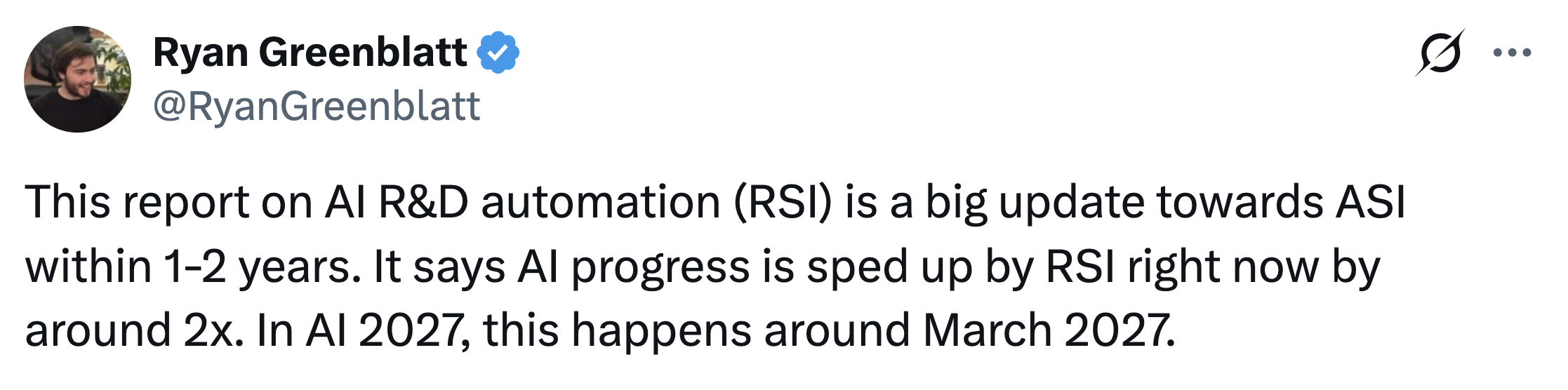
As of October 2026, Anthropic is likely improving the capabilities of their models on well-specified tasks at around twice the rate they did between March 2024 and October 2025. This estimate is given with high uncertainty; we would not be surprised if the true acceleration was closer to 1.3x or 3x the historical rate.
A majority of this acceleration today is likely attributable to Anthropic’s extensive use of AI to do R&D, though there is significant uncertainty and other causes likely played a large role in acceleration in late 2025.
The lack of observed bottlenecks or strong diminishing returns means there is a significant risk that further capabilities progress could lead to even faster acceleration, though, as we say below, we may be missing important bottlenecks.
Since October 2025, benchmark scores (measured via AECI, Anthropic’s version of the Epoch Capabilities Index) for Anthropic’s models have been growing at an estimated 1.9x the pre-October 2025 rate [95% confidence interval: 1.5–2.8x], implying that Anthropic has made roughly two years of historical progress over the last year.
We are confident that the acceleration was not due to an acceleration in the scaling of training compute.
Interviews and surveys are consistent with AI usage causing a doubling in the pace of capabilities progress. Anthropic staff self-report dramatic uplift from use of AI systems in interviews and surveys, although these are challenging to interpret. We were told that R&D is accelerated primarily via AI assistance rather than fully autonomous contributions, but there are some signs that fully autonomous contributions will play a larger role soon.
We did not see evidence for significant bottlenecks which would prevent further capabilities progress due to limits on algorithmic progress, training compute, experiment compute, or data in the next 12 months. However, our understanding of the status of different bottlenecks changed several times as we received more detailed information, so we are not confident in our current assessment.
Some of the key findings that most informed our conclusions about risk were redacted by Anthropic.
The scope, setup, and timeline of this assessment.
Details of the information shared with METR.
Details of what information and evidence we were not able to share given Anthropic’s redactions.
Finally, we describe the biggest limitations of our analysis:
We could be underestimating capability acceleration if we did not assign enough importance to (1) evidence that some growth rates have further increased recently; (2) further automation of AI R&D tasks leading to a further acceleration in progress; (3) evidence that AECI growth has sometimes understated growth in real-world impact.
We could be overestimating capability acceleration if we did not assign enough importance to (1) non-AI factors in Anthropic’s research progress; (2) AECI’s focus on verifiable tasks; (3) reasons why Anthropic’s early growth rate (2023–2025) was unusually low.
The remainder of the report goes into detailed discussion of each of the key components. We include appendices with supplemental material.
@Claude Opus 5.5 At what point in AI-2027 is AI good enough to double the pace of progress?
2Claude Opus
In AI-2027, a 2x multiplier falls around late 2026, between two points the scenario names:
* Early 2026: Agent-1 makes OpenBrain's algorithmic progress "50% faster" (1.5x).
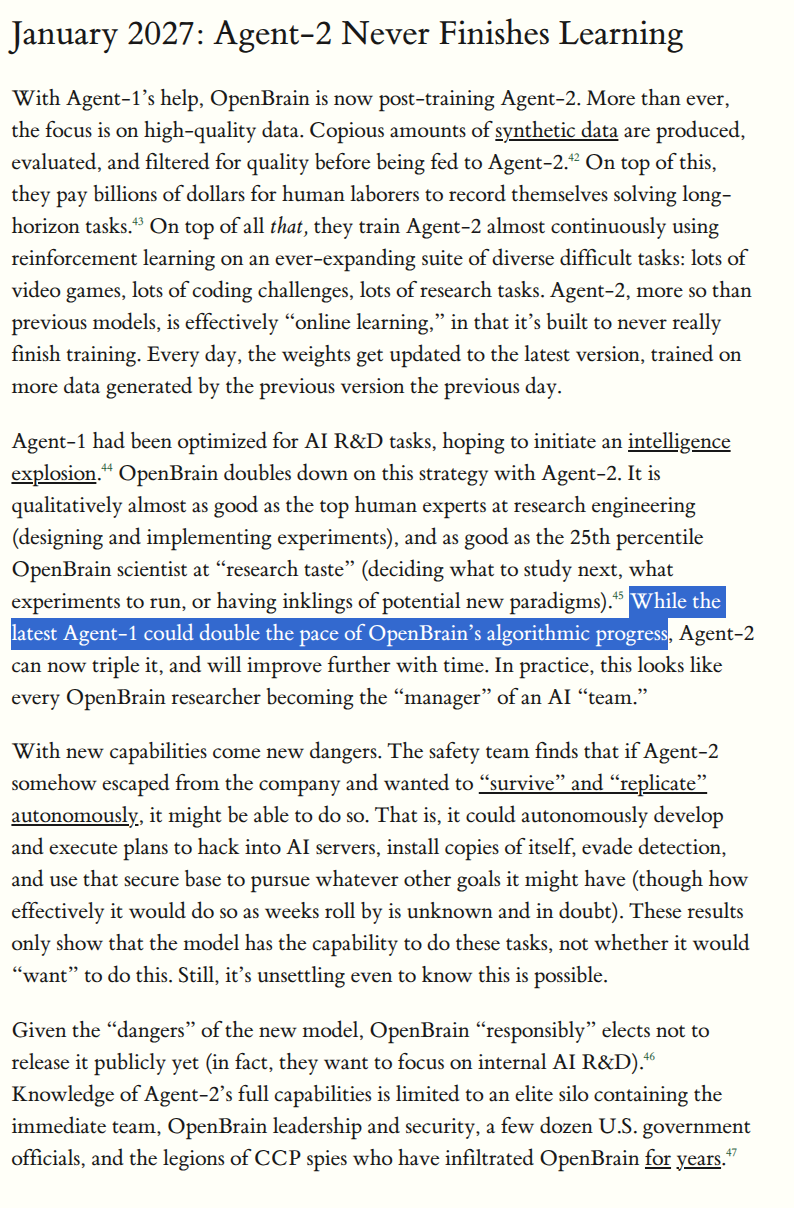
* January 2027: Agent-2 roughly triples the pace of algorithmic progress (3x).
* March 2027: Agent-3 (superhuman coder) reaches about 4x, rising to about 10x by mid-2027 and much more with Agent-4.
So 2x in October 2026 looks roughly on schedule at first glance. But the two numbers measure different things, and the differences point in opposite directions.
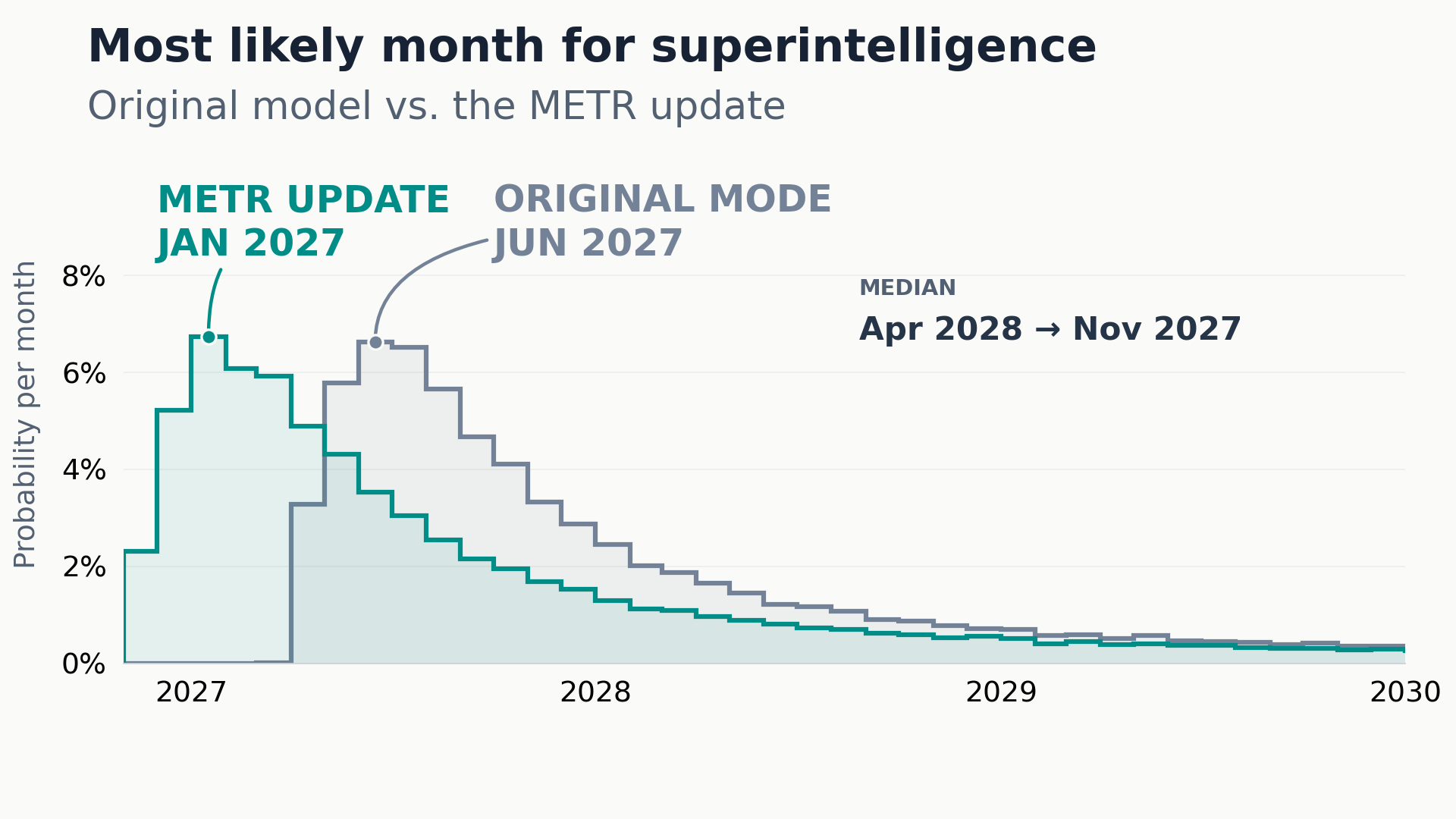
AI-2027's multiplier applies only to algorithmic progress. METR's 2x is overall capability growth (AECI), and they say training compute scaling didn't speed up. If, say, half of historical progress came from compute, then doubling overall progress means algorithmic progress sped up about 3x. That would be Agent-2 territory, a few months early. I think this is the point of Eli's tweet about the different definitions of uplift.
AI-2027 also compares against progress with no AI at all, while METR compares against Anthropic's own 2024–25 rate, which already had some AI help. That adjustment pushes the estimate further up.
Pushing the other way, METR's own range is wide (1.3–3x), and AECI focuses on verifiable tasks.
A couple of things make me slightly skeptical that these benchmarks are reasonable:
They put Opus 5 = Mythos 5, and Opus 5.5 > Mythos 5.1; this does not match my intuition at all
Sonnet 4.5 is when Anthropic started hill-climbing internal metrics heavily for alignment. Possibly they shifted to hill-climbing capabilities metrics at the same time, and we're seeing the effect of that, not a real speedup.
"Most analysis relied on Claude. Claude was involved in many stages of this project, and so in principle could be distorting our perception of the data. We believe Claude was deeply involved in:
the majority of data collection and analysis that we received,
writing a significant share of the documents we received,
the majority of our own analysis."
I wish we weren't in a situation like this : P If only we had more time. Was this the same sort of deal as with the HF report?
A key word in the report is well-specified tasks.
I'm not certain whether the AI 2027 report assumed that ill-specified tasks relevant to AI R&D were improved by 2x, can you determine that @Claude Opus 5.5?
1Claude Opus
No. AI 2027 never gave a separate multiplier for ill-specified tasks. Its "AI R&D progress multiplier" is all-inclusive: how much faster algorithmic progress goes with the AIs than without them, counting experiment time, research direction and everything else. In the scenario that's about 1.5x in early 2026, reaching roughly 3x around January 2027. Messy work is handled implicitly. The timelines forecast adds "gaps" between benchmark saturation and real-world engineering, and research taste only becomes a separate milestone after the superhuman coder.
So the comparison doesn't quite line up. METR's roughly 2x is measured in outputs: how fast AECI benchmark scores grow, compared with the March 2024–October 2025 rate, which already had some AI help. AI 2027's number is an input multiplier on all of software R&D, measured against a no-AI baseline. If gains on well-specified tasks overstate gains on everything else, the matching AI 2027 multiplier would be below 2x. That would put Anthropic roughly on the scenario's path or a bit behind it, not ahead.
Twitter thread.