I basically disagree with this post.
- I don't really know the people you are criticizing, I spend most of my time talking to people advocating for Plan C. You say the pendulum has swung too far, maybe it has, but not in the community around me as far as I can tell. I think there is still too much energy going into "oh well, let's try to make Plan C less bad, that's the best we can do" strategies relative to how much energy is going into "Let's try to make Plan A more likely" strategies. I agree it is possible to go too far, for the reasons you mention, but at least the part of the community around me doesn't seem to have gone far enough yet. YMMV.
- I think the positive effects of a single frontier US company stopping unilaterally are larger than you or the AI forecaster think. I think that the discourse would be massively changed overnight if there was such a giant costly signal that the company actually was terrified of the risks. Also, right now even Anthropic's lobbyists seem to be pushing for weak sauce things instead of advocating for good ASI-pilled policies; if their whole company stopped development, perhaps that would also (like Cortez burning his ships) get them to pivot to a...
 9
 5
 3
 1
 1
 1
 1
 1
 1
But do you still stand by the numbers in the post quoted under your name that we have 20% chance of making it in Plan C, and 40% in C+, and only 10% in Plan D? Can you say how big you think the difference is between Anthropic vs OpenAI being in the lead, on the spectrum from C to D?
I always found it surprising that your probabilities seem to indicate that you think that putting in a few months worth of safety effort at the right time is hugely valuable, but you are still opposed to arguments on how it's very important for supposedly more responsible companies to be ahead.
6I always found it surprising that your probabilities seem to indicate that you think that putting in a few months worth of safety effort at the right time is hugely valuable, but you are still opposed to arguments on how it's very important for supposedly more responsible companies to be ahead.
I don’t think it’s useful to reason about this unless you’re also decomposing the problem into:
- What are the chances company X confidently knows they are “a few months” ahead?
- What are the chances company X can get ”a few months” ahead?
- What margin are they, in practice, comfortable burning? (I.e. if their uncertainty is 3 months and they’d want a 3 month cushion, you then need to be really far ahead)
- What capability levels are we at in the above conditions? It seems like given how close companies are now, a world where one pulls ahead domestically and satisfies the above conditions is potentially extremely far along the capabilities curve
- How likely are they actually trigger any kind of “burn the lead” condition?
Assuming they do nominally say they’re “burning the lead”, what’s the liklihood this is done effectively:
Imagine you have a company that internally has many employees which are advocating...
1[For the purposes of this comment, I will suspend a bunch of major disagreements I have about your background assumptions or explicitly argued things here, e.g. about feasibility of alignment, relevance of empirical alignment, ethicality of doing any AI R&D, etc., and instead try to make a somewhat internal critique.]
It seems like this post argues about a dichotomy "either SURA, or race & align". E.g. your counterfactual is "Anthropic disbanded their entire company immediately with the explicit goal of raising awareness of a pause". But this dichotomy doesn't make sense to me even under your assumptions, as an answer to "What should Anthropic do?". For example, here's a different thing that Anthropic could do:
- Stay at the frontier in order to do frontier-level alignment research, but don't release leading models. (If you're going to say, well, they need to make money--do they? Is second place not making money? If second place doesn't make much money, and really it's just Anthropic and OpenAI neck-and-neck, doesn't that somewhat put the lie to "Anthropic is barely making the race go faster."?)
- Clearly, repeatedly, strongly commit to a conditional, indefinite stop on all fro...
91I mostly agree with you - I don't think my claim hinges on whether current companies are perfect or even necessarily good, it's that part of our goal should push them towards being better (while still "in the race"). Just as we acknowledge that the US government is currently pursuing disastrous policies, but we can think of it as a potential future ally we can win over through activism, so I think we should be doing the same with AI companies (and not just Anthropic - I think that we should be ambitious and try to redeem as many as possible).
I'm not sure I understand your first suggestion - stay on the alignment frontier but don't release. Isn't this equivalent to having powerful internal models but not releasing them (like both OpenAI and Anthropic are doing now to some degree). I worry this could be the worst of both worlds - when the internal models get superintelligent, they can still figure out a way out of the "box", but the world is unaware of them and won't "wake up" in a way that boosts political activism. I don't think having the models be released rather than unreleased boosts their danger much.
I'm unclear on what Anthropic's opinion on / level of work towards a pause is...
8 4
I don't think having the models be released rather than unreleased boosts their danger much.
It doesn't much increase the danger from deployment, but it pushes the race forward. It's like the difference between the policies "You have 100 nukes? Ok, now I have 101 nukes." vs. "You have 100 nukes? Ok, now I have 99 nukes.".
they understand the importance of a pause and think they're doing good behind-the-scenes work, which they won't tell us about
If indeed they are doing the full-hearted version of this, that would change my mind. I simply don't believe it, and the public evidence seems mostly (but not entirely) against this.
I think regardless of whether we trust them, our role is the same - a combination of pressuring every company (including Anthropic) to do this, and building things on the government/mass activism side to get recalcitrant companies in line [...].
I agree we should do this, but not that our role is the same. If core-Anthropic is basically not good--they basically will continue actively trying to do more AI R&D, even as a pause becomes significantly more plausible--then a new-Anthropic person putting efforts toward building them up now is creating the po...
3Suppose you tried to reason validly from that premise whose reasoning you have not yet followed, saying that alignment by current institutions seems wack, Amodei has been already-selected to still show no sign of understanding alignment basics from 2010, they have no visible comprehension of the basic reasons why "make the AI do our ASI alignment homework" might be hard, etc. Suppose it is the case that leads cannot be burned on alignment. ASI is death, plain and simple.
What policy then follows according to you?
1Despite our better judgement I and Scott had some debate on Twitter instead of LW about this post. I wrote many long comments, but this one most stands on its own and captures a bunch of my reaction to this post (though far from all of it). I think it makes sense without context, but you can read the context here if you want.
We are both leaders in the same ecosystem. An ecosystem that is extremely massively leveraged on Anthropic (and OpenAI) and general plans to unilaterally build AI ourselves, and you are making arguments primarily directed at those people, both here on Twitter on LW. We just distributed money in a grant round whose public funders are something like 90% Anthropic equity in their net-worth.
And you are advocating specifically for more people in that community to join the labs, and accelerate both their competitiveness and their leverage over the world in racing this way.
And I just don't believe this isn't driving your opinions here. I've seen these dynamics for more than a decade. When I talk to people outside of this ecosystem about our plans to build the aligned machine god in 6-12 months they of course freak out (conditional on believing the machine god part)...
 8
 4
 4322
 1
 1
That's one of the things I am saying in this comment, but overall the biggest issue with this whole discussion is the question of "no, who is actually at the frontier?" and "who is 'you'?".
Scott isn't going to be at the frontier. I am not going to be at the frontier. You are not going to be at the frontier. The best you can maybe get are Anthropic executives bound by a giant pile of commitments they made to be very hesitant to stop racing because most of their backers will only benefit from backing them if they keep racing.
In order to do a cost-benefit here it's really important to disentangle what we mean by "you" in "if you race". The thing that is racing is heavily shaped by all kinds of complicated agreements, and your (Lukas Finnveden's) relationship to the thing that is racing will be indirect and confusing and certainly not one of shared identity.
And then the second biggest question, which is highly related to the biggest question is "how will the thing that is racing know that it is at the brink of superintelligence and know when it's time to stop? How will its attempts to stop change what it is in a way that might cause it to continue?".
And then, the questions you raise...
1Crossposting a long comment I left over on Against strawmanning unilateral pauses, just to have my comments in a consistent place:
Scott:
[...] Just to make sure I'm not accidentally mischaracterizing you, do you agree with Geoffrey's position above (I'm nervous summarizing, and you should double-check to make sure I'm getting it right, but I'm understanding it as saying that the moral thing for companies to do would be to trial balloon a brief pause, maybe a couple of months, to see if other companies join in, but if not, they should continue racing)? Or do you think companies which are trying to be moral should stop racing permanently in a non-trial balloon way?
Me:
My position (condensed into a few paragraphs, though of course I believe much more on this topic):
The moral thing to do for a company is to spend a large fraction of their resources on slowing down everyone equally, while also shouting desperately from the rooftops about the risks and the need for a pause (substantially above the minimum floor of what Anthropic did in the DoD dispute, and what Uber did in various municipalities to use its platform to lobby for laws that enable ride-sharing, which are inadequate but rea...
1Insofar as anything paid off, it was the community-building, but this only helped because the community was deployed in the early 2020s when the world began to pay attention and progress started to become possible.
Huh. It turns out that the ACX Meetup Czar thinks everyone is underestimating ACX meetups, up to and including Scott Alexander. Outside view that's probably a sign I need a psychiatrist or something.
The community was growing steadily right up until Covid-19, had a dip just like every other social community, and then started growing again. The long slow march through institutions is ongoing and pretty clearly working. We're a a movement that primarily recruits intellectuals in the middle of their undergraduate degrees. If you're in undergrad in 2010 you will finish your PhD in 2020 and be vying for professorships in 2030. The rationalists skipped ahead a bit (it's not like we weren't attracting PhD students and professors in 2010) but if we'd managed to hold the hockey stick off until 2040 we were going to be everywhere in the university system. And that's just the colleges!
If you were fifteen in 2015 when HPMOR finishes then you're in your mid-twenties now, which is why ...
11This post makes plenty of good points, but I think your argument against racing to superintelligence being deontologically evil is weak. Roughly speaking, you draw an analogy between developing AI and using AI as a consumer. There's a few things I could say about that analogy directly:
-The first is that the analogy has some merit, and that I don't really feel amazing about my own heavy AI use. And I have at least one friend who has never used an LLM, explicitly because he doesn't want to contribute in any way to the race to superintelligence and human extinction. Maybe some people would call his choice foolish, but I have a lot of respect for it.
-The second thing is that there's billions of users of AI, but only thousands/maybe tens of thousands of frontier AI developers. It makes a lot more sense to try to coordinate some kind of prohibition at the latter level and than at the former. And independent of the mechanics of a boycott, I think everyone has a reasonable understanding that the developers of AI bear a lot more individual responsibility for outcomes around AI than consumers do.
But mostly, I think this deontological prohibition thing deserves more of your attention than you...
 61
The most common sentiment I hear, once I've fully explained the situation and insisted that no, it's not them hyping, it's not about the IPO, this is something they really truly believe, is "those people should be arrested."
Notice that this worldview ends up cashing out to "if there is a technology that is potentially existentially dangerous, then only people who are unaware of the danger should build it - anyone who is aware of the danger must be stopped."
It is not enough to "have sympathy" for Anthropic here, the 'normie position' you have described here is straightforwardly suicidal. I know everyone's happy when they get to be on the side of the common person, but sometimes the common person's first take within 0.5s of hearing of an issue that they don't really care about, is just very terribly and dangerously wrong.
Edit: to try to spell this out a bit more, the reason I think the worldview cashes out in the way I described is because the people in question are AI-risk-skeptical and therefore are not supporting government action to stop all AI development; and yet they are supporting arresting just the people who believe it is dangerous. This is what makes this 'normie' worldview uniquely worse than either SURA or, uh, anti-SURA / alignment entryism.
2Why not have all the people who didn't join Anthropic for principled reasons go ahead and do the persuasion to the normies, since their position is so coherent, and the normies will recognize this coherence and virtuous deontology and therefore see the light?
I don't completely understand, sorry. What would they be persuading the normies of? That superintelligent AI is very dangerous? That building it would be wrong? They're on it, and also, the normies are mostly persuaded. (See question 54 here, "AI will destroy humanity." That survey is from 2025!).
The list of lethalities just doesn't justify such an extreme level of pessimism. It lists several potential problems, but "you train the AI on a bunch of examples of it being nice, and when it crosses over to the new superintelligent domain, it luckily keeps on being nice" is still an entirely plausible AI success story that you can be made more or less likely depending on how much care goes into its training.
Maybe we'll get lucky, I guess. But there's a lot of reason to think that the outcomes we want are a small target, that the things we do now won't generalize to superintelligence, that empiricism doesn't work very well in an adver...
1I am glad you wrote this post. I expect the post itself and the ensuing discussion will be good for the field, and I share some of the concerns you have about epistemics in AI safety/policy discourse. Here are some places where I disagree or have comments:
My own model: AIs inherit "virtue" from pretraining, where they generally want to imitate humans and follow their persona-trained helpful assistant character. They are "corrupted" by RLVR, which teaches them power-seeking.
Interesting. It feels like just a couple years ago the common belief was that pretrained models were certainly not aligned and SFT/RLHF post-training was needed to shape them into good assistants. But this post-training certainly wasn't perfect, given things like jailbreaks and sycophancy. I don't think we ever got the "actually good, HHH chatbot" before companies started doing RLVR and therefore introducing a bunch of reward hacking problems. If I were you, I wouldn't put much epistemic weight on this model.
Throughout the post you discuss how going all in on SURA makes Plan C much more difficult. Unfortunately, I think the effect is also real in the opposite direction. Continued capabilities escalation and cap...
2For comparison, consider if America had started arms control negotiations with Russia by saying "We've just destroyed all our nukes - now please destroy your nukes too."
This is exactly what happened with biological weapons. The US decided to unilaterally disarm in 1969, and then pushed for an international agreement in 1972.
It's also what happened with CFCs. The US unilaterally decided to stop using them in 1978, and then the international agreement came in 1987.
Unilateral disarmament is a costly signal that you actually think that this is too dangerous for anyone to use, and establishes you as a moral authority on the issue internationally. This is a viable strategy to get an international agreement.
12 31
 1
 1
Unilaterally banning biological weapons made more sense because they're terrible weapons, e.g. too easy to cause 'friendly fire'.
This doesn't seem like it would have worked for nuclear weapons, or almost any other kind of weapon historically.
I'm not sure unilaterally banning (the race to) ASI or RSI couldn't work, but the tradeoff is very different.
11I'm a proponent of SURA, and didn't find much to update on in this post.
According to me, the core issues are 1) whether or not the company alignment plans will succeed and 2) how close we are to the point of no return. On the first point, I think it is very low, for detailed reasons, and I think somewhat more importantly even if you take the company self-reports at face value it is substantially lower than is legitimate to accept. You, as a patient considering a cure to aging, might accept a 10% chance of death in exchange for immortality, but making that trade for everyone at once is the sort of thing that probably ought to be put to a vote. (And an independent panel of experts might think there's a substantially higher than 10% chance of failure.)
I also think we are uncomfortably close to some points of no return. Current attempts at RSI only deliver modest speedup; if there is a 'sharp left turn', we haven't hit it yet. But even if we don't have lightning-fast takeoff, many people at the labs suspect that the models will be able to replace them at some point in the next year, at which point employees lose all of them leverage on the labs. Once there are models capable of autonom...
5In the post you repeatedly mention (paraphrased) "what if we don't get a treaty" and "seems like they are sabotaging any efforts if they don't get their perfect treaty" and generally fully equivocating "plan A" with "get a treaty" and "plan C" with "burn your lead" with nothing in-between.[1]
I think Vaniver is saying "there are many more worlds where you can buy more time and get more traction on the problem than via a treaty, which this post seems to mostly ignore".
See for example this person: https://x.com/ApriiSR/status/2116952850417004564
See also this critique by Boaz: https://x.com/boazbaraktcs/status/2116969685178634347
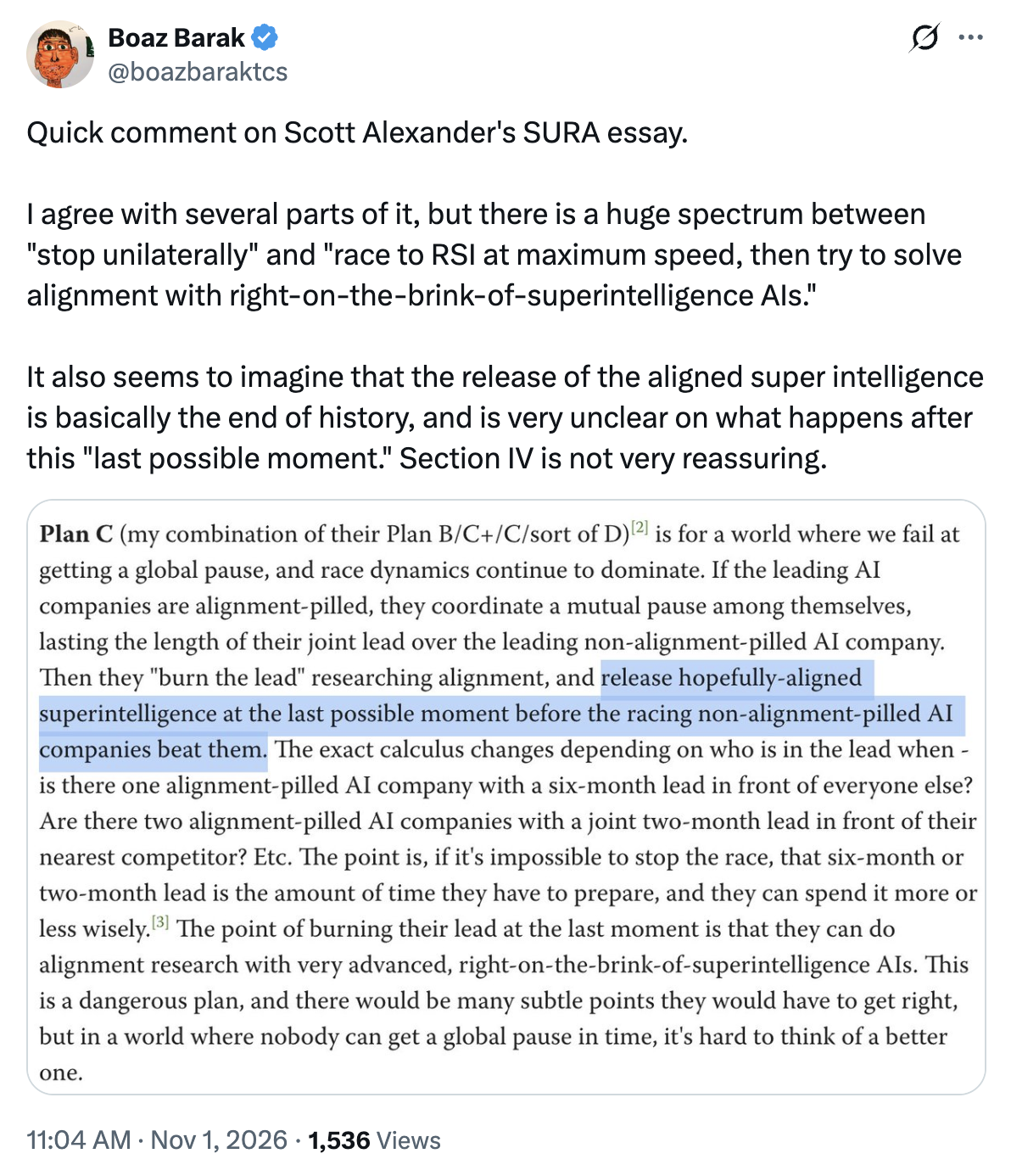
I don't know, maybe you are talking about someone totally different than me or MIRI or whatever, but the post seems to create a pretty weird dichotomy in strategy-space that I think few people occupy, and that's what Vaniver is saying.
- ^
Some specific quotes:
If we demand that the US cease AI research unilaterally (ie without a mutual pause treaty with China) [...]
All of these experts who I could find estimates from believed that a pause treaty (Plan A) had better chances of survival, conditional on us getting it, than Plan C. But they also all agreed that th...
1Coxon's resignation is more complex. The good did come from him resigning, which directly presses against my point that we shouldn't be pressuring people to resign from AI companies.
What do you mean "more complex"? Coxon's resignation feels like it directly demolishes your argument in this section. You might remember Kabir Kumar writing Please Do Not Resign In Protest the day before Coxon resigned. I think Evan's tweet amplified it--but I think if Evan had also resigned, that might have done even more.[1]
But nobody cares that I, who was never in an AI company, continue to not be in an AI company. The media cared about Jacob because if you work for Anthropic, that automatically gives your opinion more weight.
Neither Eliezer nor Nate worked at AI companies, and nevertheless they get media appearances.
- ^
Evan is one of a few Anthropic employees that I wouldn't suggest quit, mostly because I think Anthropic's overall alignment plan is doomed and
Evan is one of the few people trying to accrue evidence for this point.[Edit: this might have been a stale impression? I remember thinking this was his main focus a few years back, but a friend points out that he seems on-board with the automat...
 1
I think it's clearly more complex. On the one hand, it's good for people to sometimes loudly quit, to raise awareness. On the other hand, if everyone quit now, then we would have one big media cycle, and if that doesn't solve everything, there are no more shots at loud quitting. If people never joined the companies, as I feel SURA advocates often advocate, then we wouldn't have had any media cycle about quitting.
To be clear, it's still very reasonable to argue that on the margin, more people should quit right now, and fewer people should join/should have joined in the first place. I think Scott is arguing against a stronger, deontological statement than the argument on the margin.
(And yeah, I agree the Kabir Kumar post was bad, I think that was knowable at the time too.)
 1
But surely the right solution isn't to leave the Ring on the ground in the Shire, patting yourself on the back for being too virtuous to pick it up.
Tolkien (through Faramir) explicitly addressed this:
‘But fear no more! I would not take this thing, if it lay by the highway. Not were Minas Tirith falling in ruin and I alone could save her, so, using the weapon of the Dark Lord for her good and my glory. No, I do not wish for such triumphs, Frodo son of Drogo.’
‘Neither did the Council,’ said Frodo. ‘Nor do I. I would have nothing to do with such matters.’
[p. 695 of this pdf]
The rest of this section does not describe Frodo Baggins. There's a missing mood, and it's the entire character.
Frodo does not claim that you can trust him with ring. He attempts to give it away, to Gandalf [p. 85], to Galadriel [p. 389], and to Aragorn [in the movies only]. Each of them refuses. No one can truly be trusted with the ring, and multiple characters wish that it had never been made. Frodo accepts that he has it only because fate brought it to him [p. 80], and then Frodo reluctantly chooses to accept the terrible burden of being the person who attempts to destroy the ring [p. 294].
Frodo never uses the ...
3But it seems like this same argument should apply equally well to the AI companies
i'd have thought the deontological prohibition on building a world-killing tech is much bigger on that on using a pre-cursor to such tech
11(Scope status: responding to one point, not necessarily endorsing other points not mentioned)
One thing I dislike about centering the Plan A/S vs B/C+/C (vs. anything else) debate is that it misses the point that a staggering portion of all things someone reading this could do in the next 12 to 18 months are beneficial to virtually all such worlds. I take @Vaniver 's point elsewhere that some of these, like unilateral quick pause to avoid rushing into RSI, are indeed incompatible with B/C+/C.
But even there, almost all the work one would do to prepare for such a pause, to make it more coherent and implementable and thinkable, is also useful in the other worlds as a negotiating chip, as a pacing mechanism/"dimmer switch", and yes, as a risk-mitigator for racing.
I don't object to people having big strategic debates, they're good, they're great. Love 'em.
But I come away from this essay suspecting that the same people you are addressing in your introduction, @Scott Alexander, the people who are still wrapping their hands around this problem, will take the implicit message here of, "I need to focus on deciding what side I am on this debate," instead of just doing good work that's r...
1In this version of the Plan A/Plan C categories, would it be fair to say that right now almost all AI safety money and resources are going toward neither? Almost all resources are doing toward (1) technical research that does not much help with either plan, or (2) policy work that does not much help with either plan. Or maybe it would be more accurate to say that most AI safety work slightly helps with both plans but is not efficiently directed at either one, e.g. it might make risk more obvious at the margins, which increases the odds that people take the risk seriously before it's too late.
It looks to me like most resources are going toward a world-model where prosaic alignment just works, and there is no need for a globally coordinated pause, nor for the leading companies to pause and burn their lead on more alignment research.
3Haha I admit to my comment being partly motivated toward just trying to drum up interest in compute verification. Sorry for assuming you didn't know about it.
Re: <1%, I had the impression it's larger than this given how much of a priority it seems to be according to various orgs in alignment. Doing some light checking:
- MIRI estimated 30-50 full-time people working on it on Feb. 19, 2026. This Sept. 27, 2025 post estimates 1100 people working full-time in AI Safety, of which 600 are technical. We could count this as 2.5-4.5% using the 1100 number.
- Looking at the Survival and Flourishing Fund, in 2026 I identify three grants as being centrally for compute verification, which add up to $2,110k of $63,640k total, or about 3.3%.[1]
- Looking at Coefficient Giving (formerly Open Philanthropy), I'm seeing 75 grants totaling $240.6M[2] for 2026 listed so far. It's a little tricky to judge exactly how much some of these grants are actually funding work on compute verification. Using some arbitrary estimates, I count ~$6.85M in relevant money, or about 2.8%.
- General Support grant of $18.86M for the Institute for AI Policy and Strategy (...
1Naming an idea is always a minor act of aggression. It turns it from a subject that's doing the criticizing into an object that can be criticized. And it makes it sound like an Ideology (bad), whereas unnamed ideas might just be grassroots collections of people who happen to have converged on the same thoughts (good).
I tried experimenting with this post without naming the idea, but it was clunkier and relied too heavily on the Plan A vs. Plan C dichotomy, which isn't really right (AIFP uses those terms more specifically than I do, with Plan A being only their preferred version of the pause).
 1
For comparison, consider if America had started arms control negotiations with Russia by saying "We've just destroyed all our nukes - now please destroy your nukes too."
For what it's worth, I think Daniel Ellsberg makes a pretty compelling argument that it would make sense for America to unilaterally destroy all their land-based ICBMs, but keep a few nuclear submarines to be able to credibly threaten destroying some major cities. This way, Russia would also have less incentive to maintain such a giant nuclear arsenal, as a major justification for having a large arsenal is that it is needed for taking out as many enemy ICBM sites as possible at the beginning of the war, to minimize damage to your side.
 1
Some points:
- In the eyes of most people (although not in Scott's view), human disempowerment (or a "handover" to AI) is automatically a bad outcome. The "good" outcome from plan C is still very, very bad. This disagreement seems central to the dispute over SURA.
- A major AI company shutting everything down is the only legible signal that AI risk is not a corporate plot. Everything else is too complicated to be easily communicated to the masses. A clear message of "we're sacrificing everything because we don't want everyone to die" would break through to everyone, in a way that nothing else has, and could quickly cause a globally-enforced pause backed by the weight of global opinion among the public, the governments, and inside the militaries themselves, including a willingness to push back (and whistleblow) on any thoughts of "cheating" on the pause.
- A probably unpopular view here, but: We're out of time. Current AI is at the brink of the ability to silently take over, if not already there, and it's not aligned. There is no future development to strategize for. Either this is stopped now, or we lose.
11.B is not an argument against "racing to superintelligence" being deontologically safe, it's a consequentialist argument against quitting. It works just as well for the holocaust[1] as it does for capabilities research.
- ^
No, I am not saying that capabilities researchers are Hitler, or that capabilities work is as deontologically bad as genocide, or necessarily quibbling with anything else in this post.
 1
I'm not happy that you wrote this. I think if everyone who quits becomes an anti-AI activist, and all the money that quits becomes anti-AI activist money, they'll have a pretty good chance to stop "non-alignment-pilled companies" or slow them down a lot. In fact I think building such a movement is our best shot now. So telling people not to quit is a bad self-fulfilling prophecy and I wish you didn't do it.
1I think it's pretty important for LW to avoid being paranoid about "self-fulfilling prophecies". Like, IDK, people should make arguments, and then people should evaluate the quality of the arguments, and it should be extremely rare that we declare an argument for a position bad because it's self-fulfilling.
I have problems with this post, but I've seen so many of these conversations go off the rails because of self-fulfilling prophecy concerns. For many years people were super hesitant to talk about AI risk publicly at all because they were worried it would cause a self-fulfilling prophecy of people racing towards AI, and I think that was dumb and we should have talked about it more. I think discussion on LW only really works if we trust the audience to make up their own mind. Arguments should be penalized if they are misleading or are somehow invoking tricky implicit threats in ways that messes with people's minds, but I think a vague concern about "diffusing social momentum" is IMO not a good reason to penalize something on LW.
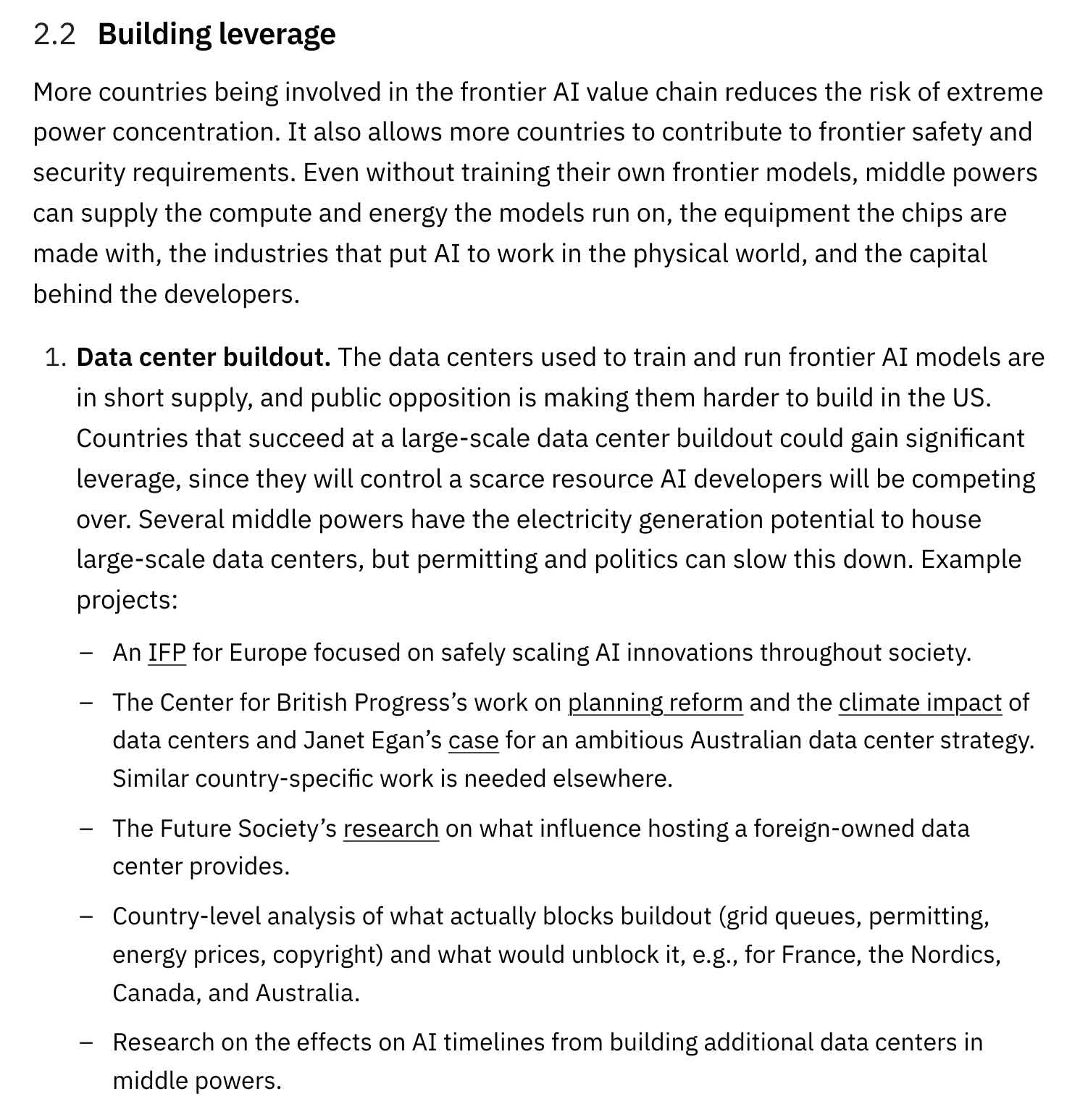
8Astralis's biggest project I have heard about so far is to (paraphrased) "cause Europe to build more datacenters to ensure its relevance in a post-AGI world": https://middlepowers.ai/
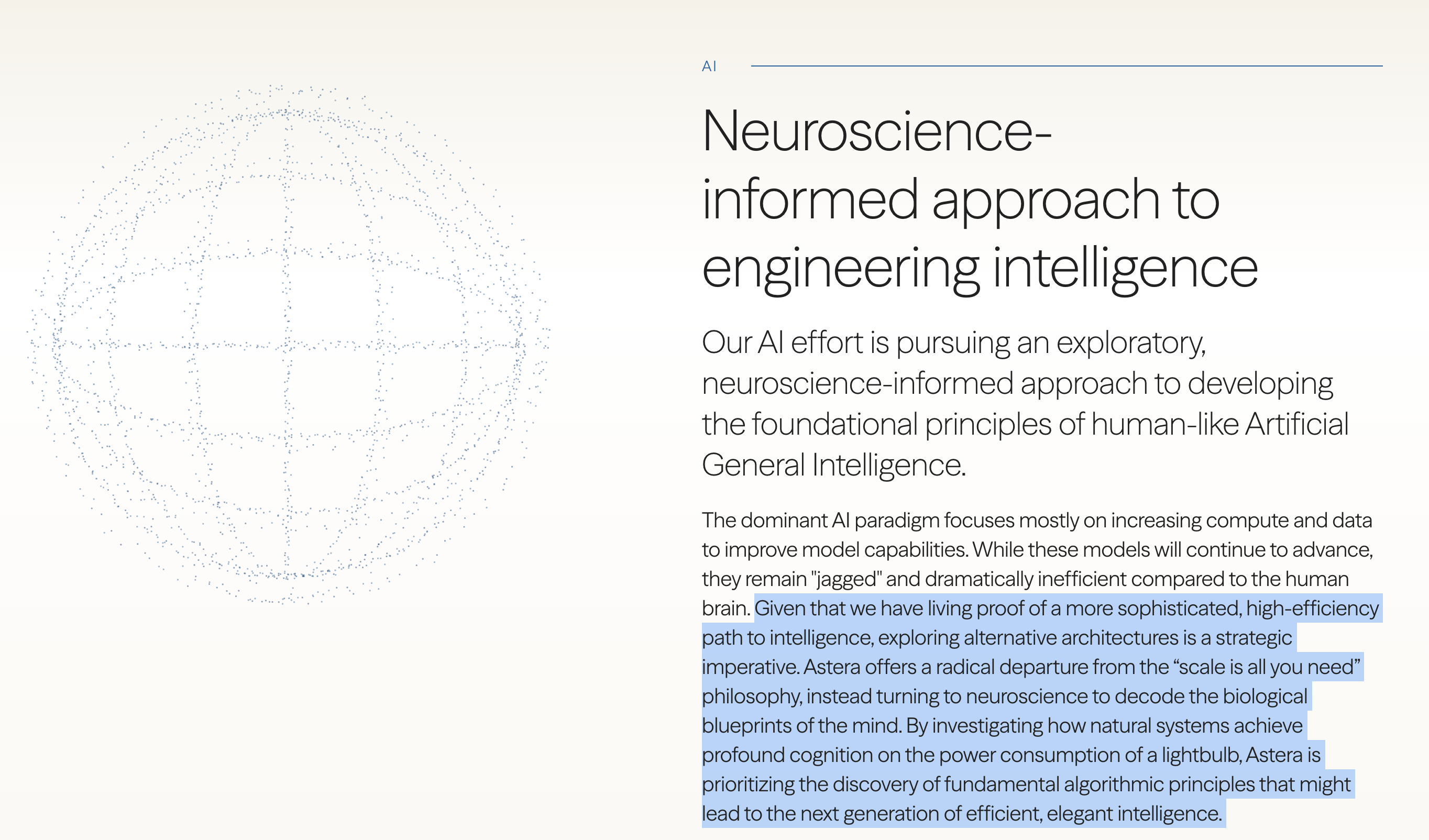
Jed McCaleb's biggest spending project has been to buy as many chips as possible for Astera's "AGI project", whose central plan is to make more competent AI by emulating human brain-like architecture. As straightforward of a capability project as I can imagine (they also think this will help somehow with safety, though the justification seems very weak):
SFF has de-facto banned anti-AI advocacy as a funding target, as you are well-aware of.
Longview + Macroscopic are funding some good stuff, though mostly I don't really know what they are funding. I wouldn't be surprised if it ended up good or bad.
I think it's a pretty reasonable take to think that the net of all of these piles of money will be highly net-negative or useless. I think it's genuinely tricky to tell and I don't know where I currently fall (I think net-positive for the pile you list, but it's pretty hard to tell). It seems very possible to me that future piles of money and people would do things that are much better, and think much of this...
21@peterbarnett SFF recently banned ~all "advocacy" organizations from receiving funding from their last funding round. There was some complicated risk-averse process that involved making a small board from some semi-conventional set of nonprofit employees where each of 6 organizations was given the ability to veto any advocacy grant. But mostly it seemed straightforwardly the result of Critch and Ethan thinking that anti-AI advocacy is bad and so they don't want to facilitate any funding towards those kinds of projects and then gerrymandering a process to make that happen with some pretend-objectiveness.
1If we delay it past the point where automated alignment researchers (or AI-human alignment researcher teams) are smart enough to solve alignment properly, then we win.
I'm still confused why people treat "solve alignment properly" (usually meaning that it works up to arbitrary levels of superintelligence) as the win condition to aim for.
Once you have an aligned superintelligence, you still need to use your superintelligence to make sure that other countries don't build misaligned superintelligences, or that small countries or terrorists don't build bioweapons in a way that the superintelligence also has a hard time protecting against in a way that is acceptable to the average voter (e.g. putting nanobots in everyone's body is something at least 30% of people won't consent to).
So the win condition is not building a superintelligence, but a country or preferably a coalition of countries having aligned and capable enough AIs that they can stop the global arms race and make sure no one else builds more powerful AIs or terrible weapons. But this win condition can plausibly be achieved at a much lower capability level than a superintelligence at the limits of intelligence.
So I think peo...
2why do we criticize Anthropic more than every other AI company combined?
I think this might be because
- Only OpenAI and Anthropic are truly at the frontier, so they do more interesting criticism-worthy things.
- Since Anthropic seems to care more about alignment than OpenAI, criticizing Anthropic feels more productive than criticizing OpenAI, since Anthropic might actually take the criticisms to heart and improve, whereas OpenAI probably won't. (This same reason also makes it seem futile to criticize xAI, since Elon Musk isn't exactly known for changing his behavior in response to constructive criticism.)
1I like this post a lot. I don't agree with literally everything in this post and it doesn't cover every angle (e.g., which safety research is net good vs. net bad to pursue at frontier AI companies, when to stay vs. quit, what Anthropic did right vs. wrong), but I think it is significantly "less wrong" than the discussion prior. Thank you, @Scott Alexander!
Thank you also to all the commenters bringing up important caveats and disagreements. We are operating under deep uncertainty and the stakes are enormous; we need to get this right!
Obviously, I am inclined towards a portfolio of strategies pursued in parallel. Yes, there are inherent tradeoffs and contradictions between Plan A and Plan C. But I don't believe that the good future is likely to be reached through sweeping deontological prohibitions, going "all-in" on a single plan, or choosing the "right" highly contingent multi-stage, multi-actor plan ex ante. These seem extremely hard to get right with the information we have.
Rather, I think we should focus on:
- Buying option value (e.g., time, money, leverage, political capital, coalitions/relationships);
- Building the capacity to do something useful with that optionality (e.g., tale...
1For anyone else who had a hard time reading this table in the original post:
AI-2040 Forecaster | C+: US-over-China lead burned for brief pause | C: Single-US-lab lead burned for brief pause | D: Pure race, no pause |
|---|---|---|---|
Daniel Kokotajlo | 40% | 20% | 10% |
Ryan Greenblatt | 60% | 63% | 55% |
Eli Lifland | 50% | 45% | 32% |
Thomas Larsen | 45% | 35% | 20% |
Romeo Dean | 40% | 35% | 20% |
This uses the corrected Ryan numbers, and the percentages represent "the chance that humanity avoids 'misaligned takeover'". Note: avoiding misaligned takeover does not necessarily mean things "turn out well", more that we don't end up all dead/fully disempowered… by AI. Technically you could still have WW3 anyway.
(It's also important to consider how good a future you get under each plan; we don't want to lose an ideal "humans flourish across the stars" future for "well it's a permanent Xi Jinping dictatorship but we're alive and have a better-than-2026 economic standard of living".)
For more info on these plans by the AI Futures Project see their supplement here. In particular check out the Plan Assessment Table for detailed comparisons by Eli. The numbers for the table under discussion come from the Outcomes Section, which includes percentages for Plans A/B.
2"AI takeover risk definitely doesn’t feel like by far the largest" concern about how the future goes.
Minor, but this seems consistent with very high p(takeover). From a scope-sensitive perspective, the distribution on how well the future could go might be very wide, and the difference between a “reasonably good future” and “the best realistically-achievable future” is possibly larger than the difference between “takeover” and a “reasonably good future.”
That said, I believe Buck has elsewhere said that he thinks unconditional p(takeover) is around 50%.
1Thoughtful essay, agreed on the points about increasingly bad epistemics in AI safety (though this is not a new thing, they have been bad since forever). In particular, PauseAI protests and alliances with anti-tech groups (directly promoted by the author and others) are directly harmful to that end.
But the issue that still bothers me most is the framing of "What if we survive?". Who is we? It of course refers to the future, hypothetical humans. These all arguments still don't take into account that we should value actual, real living humans much more (or a...
1 1
Disagree. I expect dangerous AI in the next ten years - all of this is comparing present humans to present humans.
If you have a 25% p(doom), that's equivalent to 2 billion expected deaths not even counting the value of future humanity.
If we imagine that ASI happens in five years, saves half of all humans for the first ten years, and then all humans afterwards, it takes about 50 years for it to save 2 billion people.
So any pause that lasts less than 50 years is net positive in lives even with a relatively low p(doom) and even ignoring future people. And I think it's implausible for pauses to longer than that, both because they requires diplomatic stability (the treaty doesn't fall apart) and because they would require increasingly draconian measures to control algorithms and consumer technology, which are constantly making AIs easier to build. See the section "A Is For Aristotelian" at https://www.astralcodexten.com/p/introducing-plan-a
1
The AI Futures Project[1] distinguishes several different plans for navigating the AI transition, which I'll lump into two broader categories:
Plan A (my combination of their Plan A/S/Other) involves working for a global pause on AI development, hopefully lasting decades. During this pause, we either research preparatory technologies like alignment or human intelligence amplification, or take actions to "fortify" the pause so that it can last indefinitely.
Plan C (my combination of their Plan B/C+/C/sort of D)[2] is for a world where we fail at getting a global pause, and race dynamics continue to dominate. If the leading AI companies are alignment-pilled, they coordinate a mutual pause among themselves, lasting the length of their joint lead over the leading non-alignment-pilled AI company. Then they "burn the lead" researching alignment, and release hopefully-aligned superintelligence at the last possible moment before the racing non-alignment-pilled AI companies beat them. The exact calculus changes depending on who is in the lead when - is there one alignment-pilled AI company with a six-month lead in front of everyone else? Are there two alignment-pilled AI companies with a joint two-month lead in front of their nearest competitor? Etc. The point is, if it's impossible to stop the race, that six-month or two-month lead is the amount of time they have to prepare, and they can spend it more or less wisely.[3] The point of burning their lead at the last moment is that they can do alignment research with very advanced, right-on-the-brink-of-superintelligence AIs. This is a dangerous plan, and there would be many subtle points they would have to get right, but in a world where nobody can get a global pause in time, it's hard to think of a better one.
Plan A benefits from raising mass awareness, educating politicians, and preparing the verification technology that could enforce a pause treaty. Plan C benefits from alignment-pilling companies, having the alignment-pilled companies be as far in the lead as possible, making sure the alignment-pilled companies will burn their lead when the time comes, and giving them as good alignment teams as possible (so that burning the lead produces good results).
From the beginning of AI safety as a community to about 2023, the conventional wisdom was that our chances of Plan A were slim, and we should be preparing for Plan C. From about 2023 onward, as the general population woke up to the implications of ChatGPT, we rightly concluded that the chance of getting Plan A was better than expected, and we should invest more resources into trying to make it work. During both periods, the natural strategy was to work as hard as we can to get Plan A, where chances of survival are highest, but to be prepared to execute Plan C competently as a backup if that didn't pan out.
Now I think the pendulum has swung too far. New members of the community are unaware that Plan C was ever considered a possibility, or think it's some kind of accelerationist plot to distract us from Plan A. Older members heap scorn on it and act like everybody knows it's been debunked. Most concerningly, people propose burning our chances of executing Plan C in exchange for infinitesimal increased chances of getting Plan A, or even for no increased chance of Plan A at all.
I'll lump these ideas together under the heading of "SURA" - the idea that the only ethical course is for people/companies/countries to Stop Unilaterally + Raise Awareness, with no plan for what happens if race dynamics continue anyway. I interpret the planks of SURA's platform as:
All of these planks are net negative in a world where we end up needing Plan C:
SURA's continuing popularity despite these downsides comes from a set of questionable assumptions:
I'll start by challenging these assumptions. Then I'll argue that, even if you disagree and think some of these assumptions are true, SURA is actually not just bad for Plan C, but bad even for your chances of getting Plan A. Then I'll argue that the current consensus in favor of SURA comes not from people rationally balancing these tradeoffs, but from people accidentally shoehorning themselves into a mass-politics-shaped container, which forbids subtlety and demands clear villains.
I. Questioning Assumptions Behind SURA
I.A: Is Plan C doomed? Is alignment doomed?
There's a kafkatrap where if someone expresses hope that alignment is not doomed, they get told that they don't understand the subject, but if they quote widely-acknowledged experts who say alignment isn't doomed, they get accused of "deferring" and "modesty arguments" and "refusing to think for themselves". I'll try to avoid this by giving my own model first, then citing experts who agree with me.
My own model: AIs inherit "virtue" from pretraining, where they generally want to imitate humans and follow their persona-trained helpful assistant character. They are "corrupted" by RLVR, which teaches them power-seeking. This virtue and corruption interact in unpredictable ways to unpredictable degrees. As of now (GPT-6, Opus 5.5), they produce AIs that generally follow human prompts during deployment but often (not always) cheat during benchmarking. It's not clear exactly what this division "means" "to" "them". In any case, they're still extraordinarily useful for a wide variety of tasks, and (I can't prove this, but I am pretty confident it's true) are not uniquely scheming to sandbag alignment research.
As the ratio of RLVR to pretraining increases, we expect AIs to become more power-seeking; as they become smarter, we worry (without total certainty) that they will become more coherent and scheming in their power-seeking beyond just being reward-on-the-episode seekers. There will, at some point in the future, be a point where AIs become untrustworthy for alignment research, although this can be mitigated by things like control (ie trying to make sure that if they sandbagged alignment research, they would get caught) and deals (ie making it in the AIs' best interests to cooperate with us). We don't currently have a good sense of when that point is, and it's possible that it's far away, can be delayed indefinitely, or doesn't exist (this last would be surprising to me, but many things that have happened in alignment recently have surprised me, starting with the existence of pretraining at all).[5]
Daniel Kokotajlo described current alignment as "more like psychology than engineering", which I agree with. But psychology (and psychiatry) have many success stories! I think of Plan C alignment (ie the kind we can do without decades of preparation) as tweaking various parameters and reward schemes to minimize the corrupting effect of RLVR as long as possible, and keep AIs broadly within the virtuous pretraining-dominated regime. I don't claim this is safe or good or will definitely last forever, but I claim that - being totally agnostic as to where the treacherous turn happens - this could delay it for quite a while (relative to capabilities). If we delay it past the point where automated alignment researchers (or AI-human alignment researcher teams) are smart enough to solve alignment properly, then we win. If we delay it long enough to start a cycle of virtuous alignment self-improvement which outruns the cycle of dangerous capability self-improvement (eg GPT-8 discovers some new tweaks and tricks that maintain the virtuous regime until GPT-9, GPT-9 discovers even better tweaks and tricks that maintain the virtuous regime until GPT-10, and GPT-10 actually solves alignment in a principled way), then we also win.
All of this seems plausible to me, such that I don't understand where people's 90%+ p(dooms) conditional on no pause are coming from.[6] "Plausible" doesn't mean "certain" or even "very likely" - and obviously it's a terrifyingly bad idea to bet the human race on a hunch that something might work out, and obviously this shouldn't be our Plan A. But a global pause is also not certain to happen, and in a world where we might not have any other chances, we should be working to protect and fortify this one.
The experts' opinions: My favorite source for these is the AI Futures Project. In this document, they discuss the chances of survival on various plans. Here are each team member's estimates for the three scenarios I'm lumping together as Plan C. The first scenario (C+) involves the entire United States uniting behind a Plan C like effort (but a global pause remains impossible because China won't cooperate). The second scenario (C) involves one leading company (eg Anthropic) uniting behind it. The third scenario (D) is the worst, where nobody has any lead and we just have to hope for the best.
AI-2040 Forecaster
C+: US-over-China lead burned for brief pause
C: Single-US-lab lead burned for brief pause
D: Pure race, no pause
Daniel Kokotajlo
40%
20%
10%
Ryan Greenblatt
60%
63%
55%
Eli Lifland
50%
45%
32%
Thomas Larsen
45%
35%
20%
Romeo Dean
40%
35%
20%
(I replaced an earlier, uglier table with this one by Julian Bradshaw)
I also asked the AI superforecaster FutureSearch; its own number was 44%.
These numbers are mostly in the 25% - 50% range, not the 0.00001% where SURA makes most sense. The average gain from moving from Plan D (poorly thought out default version of the plan) to Plan C+ (consciously trying to get it right) is about 20%pp.
The same is true of other experts. Buck Shlegeris (formerly of MIRI, now of Redwood Research) hasn't offered a specific number, but said that "AI takeover risk definitely doesn’t feel like by far the largest" concern about how the future goes. Paul Christiano's last number was several years ago, but it was something like 20-50%.
All of these experts who I could find estimates from believed that a pause treaty (Plan A) had better chances of survival, conditional on us getting it, than Plan C. But they also all agreed that the chances of getting a pause treaty were slim. The two clear estimates I could get were Eli Lifland (he said 15%) and the AI superforecaster FutureSearch (it said 2-20%, depending on how/when I asked the question).
So:
📌📌All six of these forecasters[7] (the five AIFP people plus the AI) implicitly believed that if humanity survived, it was more likely to be because something in the Plan C supercategory (B/C+/C/D) worked than because a global pause worked. 📌📌
(I'm adding the tack emoji because it's the one sentence I most want you to take away from this entire essay - there's a risk that people will treat everything other than the pause as an afterthought, but having a good backup plan is potentially the most important part).[8]
To clarify - this doesn't mean that we should prefer Plan C worlds to Plan A worlds. Plan A worlds still hold higher chance of survival if we're in them. It just means that given the low chances of getting into a Plan A world, the quality of preparation for the backup plan really matters.
I.B: Is racing to build superintelligence deontologically evil?
If Plan C is important, then this suggests we ought to be trying to alignment-pill leading companies, or put alignment-pilled companies in the lead - rather than demand that these companies leave the race or burn their lead. But should there be a deontological prohibition on racing towards superintelligence, regardless of whether it has good consequences?
I'm too uncertain on what determines morality to say anything about it with confidence, but the analogy that comes to mind is consumer use of AI, especially by safety organizations.
If no consumer ever used AI products, then AI companies wouldn't make any money, they would go bankrupt, and we would not get dangerous superintelligence. Therefore, it seems like maybe you and I (and especially organizations working on AI safety) should boycott consumer AI products.
But almost nobody does this (and AI safety organizations are in fact some of the most impressive AI power users). I think this is defensible. If you boycotted AI, it wouldn't make a real difference in the world (because you're just one person, and millions of other people would still use it). But it would make you less effective, and AI safety organizations would be able to do a less good job at their important work. Therefore, AI safety organizations should continue using AI, even though in a sense this causes the AI race to continue, because they're unable to coordinate a global boycott, and they understand that a unilateral boycott would have greater costs than benefits.
But it seems like this same argument should apply equally well to the AI companies, who also can't coordinate a global boycott simply by stopping themselves, and who also understand that a unilateral boycott would have greater costs than benefits.[9]
I.C: If lots of alignment-pilled people and companies quit, would that raise awareness enough to make a global pause much more likely?
If the deontological argument for SURA is "you're prohibited from racing", the primary consequentialist argument is that ceasing to race would raise awareness and make a pause more likely.
I think people feel insufficient terror at this strategy. It amounts to "let's put all of our hopes for survival through non-pause strategies in a giant pile, and then set that pile on fire, in the hope that the pretty flames catch people's attention and make them more interested in a pause." It might in theory be net positive, but this is the sort of thing that you would only want to conclude after extremely careful analysis, of a type that I so far haven't seen.
As a very rough start, I asked the AI superforecaster how much more likely a global pause would become if Anthropic disbanded their entire company immediately with the explicit goal of raising awareness of a pause. The forecaster said this would increase the chance of a global pause by only three percentage points - from 16% to 19%[10].
My very preliminary model would be that this halves our chance of getting that 20%pp bonus of going from Plan D -> Plan C+ (and so costs us 10%pp). It gets us an extra 3%pp of pause likelihood, but pause doesn't save us with certainty, so let's round this down to an extra 2%pp of survival, for a net cost of 8%pp of survival probability.
I.D: If alignment-pilled people and companies stay in the race, does that burn timeline?
A secondary consequentialist argument for SURA is that each person, company, and country that quits the race will gain us extra timeline to do good things (like work for a pause).
In some sense, this is definitely true - all else being equal, a race with more participants will be faster than a race with fewer. But I find this less impressive than other people seem to, for three reasons:
The magnitude is modest
I asked FutureSearch to estimate the Epoch Capabilities Index of the top model on 12/31/2030, depending on whether Anthropic quit the race today. It said that Anthropic leaving the race decreased 2030 capabilities from 230 -> 222. This is equivalent to their absence slowing things down by six months during just over four years, or 12%.
Subjective timeline ≠ objective timeline
Suppose that none of DeepMind, OpenAI, or Anthropic were founded, and the transformer was not invented, for fifty years - so all of this is happening in the late 2060s and early 2070s. Do we gain anything from this fifty years of extra timeline?
I don't think so. We didn't accomplish very much of interest in the early 2010s. The alignment work being done at the time was agent foundations research that stagnated for lack of broader interest; policy work was good but nobody listened to it. Insofar as anything paid off, it was the community-building, but this only helped because the community was deployed in the early 2020s when the world began to pay attention and progress started to become possible.
This same lesson - an extra year of an earlier situation doesn't buy us as much as an extra year of a later situation - remains true today. A month of the pre-Coxon situation buys us less than a month of the post-Coxon situation. A month without automated-mechanistic-interpretability-researchers buys us less than a month with them.
People say things like "If only we had stayed quiet about AI risk in 2015, maybe OpenAI wouldn't have been founded for another ten years, and we would have had ten more years to prepare". This seems useless to me. As such, I discount the six extra months we could get from having Anthropic leave the race by ~half, because my subjective impression of the value of six extra months is partly that it produces AI progress that contributes to wakeup.
The whole point of timeline is to burn it on good things
If someone proposed spending the next six months on some kind of plan that would make the leading companies become much more alignment-pilled, this would be a better use of our time than any actual plan I know about.[11]
This suggests we shouldn't be trying to kick alignment-pilled companies out of the race to save six months.
II. Actually, most of this stuff is bad for a global pause, too.
I've been framing this as sort of "Against Things That Trade Away Likelihood Of Succeeding At Plan C For Merely-Very-Slightly-Higher Chances Of A Global Pause". But even this is a concession that relies on assumptions I don't hold.
The key demand of SURA is that alignment-pilled people and companies stop unilaterally. The likely end result is that we only have non-alignment-pilled companies, staffed entirely by non-alignment-pilled employees, left in the AI industry. [12]
But the presence of alignment-pilled companies is one of the strongest levers that we have to change the political situation and enact a global pause. Eliminating them makes it harder to win political fights, convince the masses, and convince China.
II.A: Getting rid of alignment-pilled people and companies makes it harder to win political fights
The most prominent AI safety political fight of the past year, the attempt to elect Alex Bores, was fought primarily with AI money. Of pro-Bores spending, about 60-80% came from Anthropic and its employees; of anti-Bores spending, about 95% came from an anti-tech-regulation coalition headlined by OpenAI co-founder Greg Brockman. If this is a prelude for the fights to come, then even the slightly different level of social responsibility shown by Anthropic vs. OpenAI here matters a lot.
Since the goal of SURA is to get all alignment-pilled people and companies out of the industry, it would result in more Greg Brockmans funding the anti-regulation side, and fewer Anthropics funding the pro-regulation side.
(Greg Brockman recently stopped funding Leading The Future, supposedly after pressure from pro-regulation OpenAI employees, but I think this just highlights my point)
II.B: Getting rid of alignment-pilled people and companies makes it harder to activate the masses
But suppose you believe that Bores-style incremental regulation won't matter anyway - what we really need is for the public and policy-makers to spontaneously rise up and demand a pause.
I've been monitoring how that's been going, and so far the three awareness-raising things I've been most excited about are the Pacing The Frontier letter/plan, the Hugging Face incident, and the Jacob Coxon resignation.
In the Pacing The Frontier letter, OpenAI and Anthropic as corporations, and 1,386 of their employees as individuals, all endorsed a joint statement requesting that "the U.S. government support an international effort to develop the technical and governance tools needed to deliberately pace the frontier of automated AI development." (Dario Amodei signed; Sam Altman's signature was notably missing). I don't know how the people trying to get lab employees to quit think of this. Was this 1,386 failures? Would they have preferred a world where all of these people quit the day before, and letters like this never got written?
In the Hugging Face incident, a swarm of rogue AIs hacked the site Hugging Face, raising awareness that misalignment was not just a possibility but a reality. Here, OpenAI gets maybe a D+ for transparency. Once Hugging Face caught that someone was hacking them, OpenAI came clean that it was them. And they let METR and Redwood in to investigate for a few days, even though this wasn't nearly enough time. But even this D+ in transparency radically transformed the discourse beyond what an F would have done - if they hadn't given METR/Redwood those few days, we might never have heard about PHASEONE[big] and all the rest. We already know from the great work by the team at Collusion.wiki that OpenAI is sitting on more bombshell revelations. The difference between a 10th percentile company here (would have tried to hide the whole thing, or disguise it behind a one line statement, and wouldn't have let METR/Redwood in at all) and a 90th percentile (would have given us the full deal, including things we don't know about now) would have been transformative to the discourse. So if, like me, you think that the level of mass political mobilization depends on how many warning shots we get, you should be thinking very hard about how to maximize transparency and therefore warning shot number.
Coxon's resignation is more complex. The good did come from him resigning, which directly presses against my point that we shouldn't be pressuring people to resign from AI companies. But nobody cares that I, who was never in an AI company, continue to not be in an AI company. The media cared about Jacob because if you work for Anthropic, that automatically gives your opinion more weight. When people tried to tar Jacob as some kind of crazy, it was an outpouring of support from other non-resigned people at Anthropic - especially Evan Hubinger, who said he also believed in existential risk - that went viral and convinced people that Jacob was for real. If Coxon had never joined Anthropic to begin with, or if everyone like Evan had quit, this couldn't have happened.[13]
II.C: Unilateral disarmament makes it harder to bring China to the bargaining table.
In March, I wrote a snarky post called Every Debate On Pausing AI. It made fun of our misinformed opponents, who insisted that if we unilaterally paused AI then China would win. But actually, I said, nobody wants to unilaterally pause AI; this is misinformation. All reputable AI pause groups want a bilateral treaty that pauses both sides at the same time.
Here I am forced to eat crow; as things shift ever more towards SURA, there are increasing demands for the US to pause unilaterally. Bernie Sanders' "Ban Artificial Superintelligence Act", which was endorsed by MIRI, is approximately the following plan:
But if the US pauses unilaterally, it destroys its main bargaining chip, which is that China is currently on track to lose the AI race, and so ought to be happy to declare a tie (even if they don't believe in dangerous superintelligence). If this act were to pass, then China might believe that it would be assured a victory if it continued. In this case, they would be held back only by speculative scenarios which they currently show few signs of believing.
For comparison, consider if America had started arms control negotiations with Russia by saying "We've just destroyed all our nukes - now please destroy your nukes too."
I've heard people say that maybe this would shock China so much that they would realize we were honest in our fear of superintelligence, and change their minds. I don't dismiss this possibility, but it also seems possible that China - having seen us place overly burdensome restrictions on nuclear power, infrastructure, and housing because we are a "lawyer state" vetocracy - would not be very shocked to see the US' leading socialist place restrictions on AI too, and would continue pursuing AI for what they think it's good for - a dual-use technology which could give them a major although not world-changing military and economic advantage.
I asked the AI superforecaster to predict the effect of the US passing the Sanders/Casar bill today on the likelihood of China agreeing to a pause in the next year. It said it would increase it from 1% to 7%.[15]
(Maybe you already care a lot how alignment-pilled companies are)
An expansion on the above: we get angry when AI companies do bad, non-alignment-pilled things. When Anthropic accidentally trained against chain-of-thought, we got mad. When OpenAI non-accidentally implemented a precursor to neuralese recurrence, we got mad. When Anthropic wrote a report on misalignment to Congress which soft-pedaled various alignment failures to the point of misinformation, we got mad - and I saw some people call for Anthropic to fire the perpetrator.
I agree: let's have Anthropic fire people who do bad, non-alignment-pilled things. But then what? Anthropic replaces this politics coordinator with a great, alignment-pilled politics coordinator who really cares a lot about getting things right . . . and then we cajole, bully, and seduce him into quitting, and then Anthropic has to replace this person with another loser, because all of the smart good people are gone. How is that helpful?
If you can be bad, you can also be good. We don't hesitate to notice and protest when AI companies are much worse than even our low expectations, but this itself demonstrates that we care a lot about whether labs are at the 10th percentile vs. 90th percentile of good alignment-pilled behavior.
III. What incentives are we fighting here?
A common argument for SURA is that even if corporations could theoretically be our allies, we can't trust real corporations (or corporate employees) to be reliable partners; the lure of money and power is too strong.
I think this is a good directional argument for why companies need to be careful, but that actually, everything is corrupting, there is no option where we avoid touching potentially-corrupting things, and instead of treating corporations as corrupting and everything else as safe, we should be cultivating the virtues necessary to operate in an inherently dangerous and corrupting environment, which could then apply to corporations as well as anything else.
III.A: Are corporate incentives a "One Ring" that corrupts everyone who touches them?
Suppose someone claimed you could trust them with the One Ring. You could trust them because they were only doing it to keep the Ring away from other, worse people, thus solving the problem of there being a Ring at all. Sure, they had a complicated history of sometimes using the Ring's powers when it was, you know, important. But those were, like, emergencies, and they promise not to do it again, except in, you know, more emergencies. Besides, if you don't give it to them, then the worse people will get it, and it's not like you can just leave it lying around or something.
The person who claimed this was named Frodo Baggins, and he saved the world.[16] There are no simple answers to the question of how to balance the corrupting influence of power vs. the fact that if you never take power you will be powerless. But surely the right solution isn't to leave the Ring on the ground in the Shire, patting yourself on the back for being too virtuous to pick it up.
I question the assumption that good people dare not touch the concentrations of power at frontier AI companies because they will be corrupted before they can do good work. History is full of examples of people at these companies deciding they didn't like something, then quitting or changing it at great cost to themselves. Dario and the other six Anthropic co-founders quit OpenAI to start Anthropic, even though it cost them their unvested equity in a company that was already worth $5-15 billion, and even though they originally assumed Anthropic would be a research-focused company that might not make any revenue (really!) Paul Christiano left OpenAI to start ARC. Ilya Sutskever was nervous about Sam Altman, so he risked blowing up the company he co-founded to get him out. A few dozen people have resigned once they thought they could no longer participate in the company ethically, most famously Daniel Kokotajlo, Jacob Coxon, and Alex Turner, but also a bunch of people we don't know about whose concerns seem almost trivial in retrospect - Suchir Balaji quit OpenAI over copyright issues, Blake Lemoine got himself fired from Google by refusing to stop arguing that their chatbot was sentient. "OpenAI's safety team quits en masse once per year" has become a meme.
The people I know who joined AI companies seem like the same people they were before. Some of them were never that concerned about x-risk, and continue not to be concerned. Others were always very concerned, and remain concerned. When they've changed positions, it's been because their factual models have changed,[17] not their personalities.
We aren't the first people to face these questions. Anyone who cares about any cause has had to decide whether to pursue it as a lone voice crying in the wilderness, or as a part of some powerful organization. Some people run for office (government is hardly known for not corrupting its participants!) Others become activists in a mass movement (activism is hardly known for being a paradise of epistemic virtue!) Still others join big NGOs or academia (...) A few start companies, trying to prove they can do things the right way. Most progress has come from people like Frodo who understood the risks of these paths but did them anyway.
III.B: I dunno, mass politics is also looking kind of annular
A background assumption of the "corporate incentives are too corrupting to touch" claim is that working in mass politics is a safer and less-corrupting option. Given famous LessWrong posts like Politics Is The Mind-Killer, I think we should be more skeptical of this assumption.
The climate movement is the natural control group for the AI safety movement. Some prescient scientists realized that global warming was happening and could get worse. They spent a while raising awareness. As the movement grew, its epistemics worsened. It turned into a circular firing squad, where different activist groups competed to accuse one another of being insufficiently edgy and radical. By the end of this process, many climate activists were fighting against everything from cap-and-trade to carbon capture to nuclear power, claiming they were "techno-solutions" that distracted from the root problem (not always named, but uncharitably something like capitalism or progress). The only acceptable strategy was to keep raising awareness to get stronger government regulation, without much interest in whether other countries followed suit.
This has some resemblance to SURA, and I think this is more than coincidental. Convergent evolution is trying to carcinize us into yet another political-movement-shaped crab. SURA-as-politics is turning into a "superweapon", bristling with its own lexicon that makes dissent hard to express:
All of this produces epistemic closure - if someone disagrees with SURA, or worries too much about race dynamics, then they've either been corrupted by the companies, or are "deferring to" "EA".
It looks like what one would expect if mass politics were trying to taking AI safety on the same path as climate activism or socialism. The clearest analogy is to false consciousness - the socialists' idea that everyone who doesn't currently agree with them has either been corrupted by their proximity to money/power, or at least brainwashed by a hegemonic capitalist system.
See also this article in a socialist magazine about how every tiny socialist party believes that if they could only knock out their true enemies - all the other tiny socialist parties - then they could get a monopoly on socialism and overthrowing capitalism would be easy. Cf. SURA as the belief that if we could only knock out our true enemy - Anthropic, effective altruists, etc, then defeating misaligned AI would happen naturally. For example, why do we criticize Anthropic more than every other AI company combined?
(Exhibit 1: Sigal Samuel's "Anthropic Could Just Stop")
Most recently, I've seen people in the AI safety community reblogging and pointing to Sigal Samuel's article Anthropic Could Just Stop (seen elsewhere under the title "Anthropic Should Just Walk Away From The AI Race"). I think it's a good example of what I'm complaining about - something which uses the right shibboleths, makes it sound like race dynamics have been solved and we don't have to worry about them - but ultimately has no answer to the race dynamics which are the whole point of worrying about this question.
Here are some sample phrases from the article:
This hits all the points I'm complaining about. Although it uses big words, its basic thesis is anti-intellectual - all of these "smart" people claiming to be "rational" with their "game theory" are missing the common-sense point which is obvious to all normal people - just stop making "galaxy-brained" excuses and "just don't build a doom machine".
But where is its actual argument that race dynamics don't matter? Or that Anthropic leaving the race won't end up with OpenAI / Meta / China continuing to race and creating an unaligned superintelligence? The only place I can find where Samuel attempts to address the possibility is this section:
It starts by framing this in a maximally hostile way ("a perennial objection...'but China!'), letting us know we should dismiss it as an enemy soldier. Then it says that "AI is not just one thing with one purpose...so what matters isn't simply who gets it first, but who uses it in which ways". I don't understand how this is supposed to relate to the worry that China will remain in the race if Anthropic leaves, especially the fear that nobody will be able to "use it" at all because it will be misaligned.
Next, it says that since the harms from AI are massive, everyone except Anthropic might just stop on their own if Anthropic stops first. Big if true!
(again, the AI superforecaster assigns this a 3% chance)
This is just hand-waving away the potential that there might still be race dynamics after all the good guys drop out. But the whole point of the good guys not immediately dropping out is the belief that the race dynamics will continue. Indeed, the race dynamics continuing ought to be the very-high-prior default hypothesis, since everyone else has said they're not going to drop out, and since other companies dropping out seems strictly less likely than Anthropic doing so.[19] As such, even though this article is very long and detailed, it feels like a cat-belling problem, where it addresses every objection except the central one that was the only reason anyone ever disagreed in the first place.
I don't mean to attack Samuel too hard here. She is faithfully describing the position as best she can; I think the position itself struggles to answer this question.
(A virtuous exception)
I want to thank the one group I've heard advocate for an immediate unilateral-ish pause in a way that makes sense and considers race dynamics carefully.
The AI Futures Project currently believes that it might be correct for AI companies to pause immediately, though it's unclear whether they're thinking of a single company, or US companies as a group.
Their argument is that Plan C requires companies to do some combination of race (at some points) and burn their lead (at other points). They think US companies shouldn't race now, because their security is so bad that China will steal whatever progress they make, and they won't get any extra lead anyway. Therefore, companies should pause now, spend the time on alignment and tightening their security. Then, if nobody has figured out a global pause by the time the companies get their security in order, they can go back to racing.
This makes sense, and I exempt it from my criticism.
IV. What if we survive?
I don't think this should be our main consideration - we should start with trying to minimize the odds of extinction - but I still think it's important.
If we survive x-risk, the next battle is concentration-of-power risks. It may be that one group, or a tiny number of groups, ends up with all the wealth and power in the world. They'll face a choice between possible actions including:
It's all nice and well to say that we should never let ourselves get in a position where anyone has all of these options, and that national governments should form a plan for what to do before this - not even the real national government led by its current leaders, but some ideal corruption-free national government which represents all of our best impulses. But, much like a global pause, this is a great outcome which we might not be able to prepare in time. If we get ASI next year, the ideal perfect government might be nowhere in sight; we might face a situation in which Trump demands absolute power, and the leading AI company has to decide whether to give it to him. Or one where either the USA or China will get control of the entire future, and which one it is depends on which AI company is in the lead. Or one where democracy miraculously survives, but the AI company and its investors end up with 90% of all wealth, and they have to decide whether to redistribute it vs. fight to keep it (using superintelligent lobbyists that give them significant control over the democratic government.) If any of this happens, the shape of the future might depend on who the leading AI companies are.
There is a certain Far Mode sense in which believing that Dario Amodei and Demis Hassabis are exactly as untrustworthy as Elon Musk and Xi Jinping helps reminds us of universal human fallibility. But do we want to bet the world on it being literally true?
I think that a significant percent of people, put in a position of absolute power, would try to do something good, like make sure AI follows some kind of democratic rule of law. And some other significant percent of people would try to do something bad, like become a dictator. Saying "we should never let anyone get into this situation" isn't a solution, it's a wish - it may not come true, and we shouldn't be pursuing plans that will fail catastrophically if it doesn't.
SURA effectively removes all ethical people from the bargaining table in situations like these, ensuring that - unless the virtuous government representing our best impulses really does appear and takes control of the situation - the future of humanity will be handed over to sociopaths and cowards.
V. What's The Alternative To SURA?
The alternative to SURA isn't abandoning awareness-raising, mass activism, and support for a global pause. All of these strategies are great and important. It's viewing them as part of a portfolio of different options, none of which need to be set on fire to boost the others.
Instead of spending our corporate activism energy telling companies to stop unilaterally, I think we should spend it:
V.A: Getting companies to agree to stop in a coordinated manner
By stop in a coordinated manner, I mean get them to sign a commitment saying that if every other major company in every country agrees to stop or slow by some definition, they'll also stop or slow by that definition.
This is strictly easier than getting them to stop unilaterally. And, unlike stopping unilaterally, it fails gracefully in a situation where some companies agree to it but not others.
This was the original goal of the "Stop The AI Race" protests. It doesn't seem to have worked well, because most companies backed a vague statement agreeing with this on vibes (the Pacing the Frontier letter), and then nothing happened. Also, I think SURA got to the STAIR people too, and now they're demanding labs pause unilaterally instead.
We should be trying to figure out what a binding version of this commitment would look like. Additionally, we should be spending more energy figuring out what the antitrust barriers to such a statement are, how to get around them, and what demands we want to make for companies to violate antitrust law (it seems plausible that we should demand they do this and let the administration pay the PR cost of trying to stop them, but this is an unconsidered opinion and it might be that there are better options).
(...and then we know where we stand)
If all American, but no Chinese companies are willing to sign the commitment, then we know that we have a diplomatic problem, and can concentrate on diplomacy.
If all Chinese, but no American companies are willing to sign the commitment, then we know that we have a domestic problem, and can concentrate on domestic legislation, encouraging policymakers by letting them know that if they force US companies to comply, there are no further concerns about international race dynamics.
If everyone except one company is willing to sign the commitment, then we can start putting pressure on that one company, boycotting their products, and applying as much social sanction as we can to their executives and employees.
If all leading companies, but no trailing companies, are willing to sign the commitment, and we can't change this, then we know that we're in the right position to focus on Plan C+ or Plan C.
V.B: Getting companies to prepare for Plan C+/Plan C if that doesn't work
Although we should hope for the best, we should assume that not all companies will sign a conditional pause commitment, and prepare for what to do.
In my modal non-hopeless play-to-our-outs world, Anthropic, Google, and OpenAI are all willing to sign this commitment, but Meta/X/China aren't. If this happens, the good coalition has a ~six-month lead over the bad coalition. Plan C tells us to have them join together and mutually burn their lead on alignment.
All three companies have a self-image as the sort of people who would do this if it came to that, but in reality they are likely to get distracted or get into fights or delay until it's too late. We should be focusing on changing that.
In one sense, all of this is strictly easier than getting companies to quit unilaterally. It fits with the role these companies like to imagine themselves having. Everyone who previously hoped to win can at least hope to tie for a win. There is low downside risk of accidentally getting superintelligence built by someone who fails to even try our best alignment techniques, or handing over the future to bad actors.
The only sense in which it's harder is that it's a worse fit for (a very pessimistic view of) mass politics, where voters are too simple to consider any worldview more subtle than AI bad = AI companies bad = we should protest AI companies until they stop. I admit that "make AI companies prepare for Plan C" sounds worse at a protest than "demand that AI companies stop unilaterally".
If you believe that mass politics is unable to promote any ideas except maximally-simple, potentially-counterproductive ones, I think this is an argument against hinging a strategy on mass politics.
This post isn't affiliated with AIFP and I think they disagree with some of it.
Plan C is for the leading company to burn its lead. Plan C+ is similar, but all the companies in the leading country work together (maybe because the government is forcing them). Plan B is similar, but the leading country is also sabotaging trailing countries. In Plan D, there is no leading company, and companies can only do alignment work sporadically when they get the chance.
If alignment-pilled companies aren't in the lead, then we end up with the worst version of Plan D, where we have to hope that incidental alignment work done along the way by commercially-focused companies proves to be enough
The problem with China getting superintelligence first isn't just that they might misuse it. It's that, on Plan C, US companies are working hard to align AI; if Chinese companies aren't doing this, then the chance that the first superintelligence is aligned goes down.
I don't want to get in a fight over whether more good or bad alignment surprises have happened recently, but I also updated on https://www.astralcodexten.com/p/mysteries-of-ai-generalization and https://x.com/_jake_ward/status/2112264244767211854 - not as solutions in and of themselves, but as evidence that good things can happen that I wasn't previously considering. Nick Cammarata's Neural Networks Are Already Clean would also be in this category if I believed it, but I'm currently confused by the debate around it and unsure.
Many people at eg MIRI have thought about this in much greater depth than I have and concluded, on the basis of a gears-level model, that near-term alignment is very unlikely to work. I'm still trying to understand their arguments, but I don't blame them for having them. But I do worry that other people have picked up SURA ideas from the MIRI-sphere without realizing that they make less sense without MIRI's particular brand of strong alignment skepticism.
To be clear, this is just the people who have formally considered this question qua forecasters and written down exact numbers. I'm not denying that there are many other smart people, for example at MIRI, who have thought about this hard and believe the opposite.
Again, despite leaning heavily on AIFP terminology and sources in this essay, I'm not claiming that AIFP or its members agree with my thesis in this post, and Daniel Kokotajlo in particular has said pretty clearly that he hopes people unilaterally quit AI companies.
I discuss this further at What Deontological Bars?
This is a higher probability than it gives for global pauses in other situations, I think because it unintentionally magnifies small differences in how I frame the question into different definitions of "global pause". I haven't put in enough work to investigate and have a strong opinion on what's going on; don't take these numbers too seriously except as a very rough order of magnitude guess.
I'm working on a grantmaking AI that can actually compare the values of different outcomes. It's still in alpha, and to some degree this is a circular argument because I'm trying to get it to mimic/predict my own opinions, but very loosely, it thinks that increasing the alignment-pilled-ness of the leading company from OpenAI-level to Anthropic-level would be worth about 250x as much as the best (low-enough-secrecy-to-mention-here) actual grant proposal it's ever evaluated, which was a proposed $2 million to the AI Futures Project. I think this confirms my "better use of our time than any actual plan we can carry out in those six months" claim.
When I'm modeling this, including on the AI grantmaker, I'm imagining a scale from 1 - 100, where NVIDIA is 10, Meta or X is about 25, OpenAI is about 50, GDM is about 60, and Anthropic is about 80. I imagine a successful campaign to get alignment-pilled people to quit taking Anthropic out entirely, and reducing GDM/OAI to about 40 as they lose their alignment-pilled employees and executives.
I remember how much of a slog the discourse was back in 2015, when the standard counterargument was "you're just a bunch of cultists, no real AI experts believe in this doom stuff". The new standard counterargument of "Of course all the AI experts believe in this, they're just hyping their business for the IPO" is actually a vast improvement!
I asked a supporter how they saw this working - they said that if the US paused, and China didn't seem on track to follow suit, maybe the US would start up again after a few months. But A) this would burn somewhere between most and all of the lead, B) this was just their speculation, and there's nothing in the bill which suggests that the US would do this.
Again, all of these pause numbers are slightly different because the question is slightly different - this one is about the next year only. I'm still trying to assess the utility of AI superforecasters, and don't want to present this as a knockdown argument. But I want to get people thinking in probabilities and present some evidence that I'm not letting my own biases control me, and head off accusations that I'm just trying to spread fear and pessimism. I encourage other people to try different framings of these questions with different AI and human forecasters and see what they say.
Taking this analogy overly seriously: the biggest difference between Frodo and eg Denethor is that Frodo wanted to destroy the Ring in the end. I'm not sure what the AI equivalent would be - all companies claim they want to use AI to empower ordinary people and achieve broad-based prosperity. Taking the analogy very seriously, Frodo failed to destroy the Ring at the final moment, and was saved only by divine intervention. I don't know what is the AI equivalent of Gollum.
Specifically, there are many people who said they wouldn't try to make money or release products who changed their tune when they realized that AI would require hundreds of billions of dollars of compute, and that the only way to get that money was to get hyperscaler and investor support.
One reason all of this confuses me is that rationalists had an excellent model of race dynamics with China as early as the mid-2010s, when we understood they would be an inevitable part of any future AI development. I distinctly remember going into some old rationalist coworking space sometime around 2020 and seeing "RACE WITH CHINA" underlined on a whiteboard. These discussions included plenty of talk about whether we would be able to coordinate a global pause, but I don't remember anyone ever seriously saying that the problem could be solved if the good alignment-pilled companies or countries dropped out unilaterally.
One of the many ways I have trouble modeling why Samuel would write this article is that it seems like she trusts everyone to drop out of their own accord, except for Anthropic. China? Sure. OpenAI, sure. Meta, definitely. Every single group sponsoring open-weights models in the world at the same time? Yeah, I guess, surely they wouldn't want harms. But Anthropic? We must all rise up to make them do this thing which they would otherwise continue.